
Predictable infrastructure is the backbone of a sane business operations.
Yet, for most SaaS and course teams, video hosting remains the most volatile line item on the balance sheet. You likely started with a $19/month “Starter” plan, thinking you’ve secured a bargain. Three months later, after a successful launch or a viral tutorial, you’re staring at an automated Invoice Anxiety bill for $640. For solopreneurs, finding affordable video hosting that remains predictable is often the difference between a sustainable business and one crippled by “Success Taxes.”
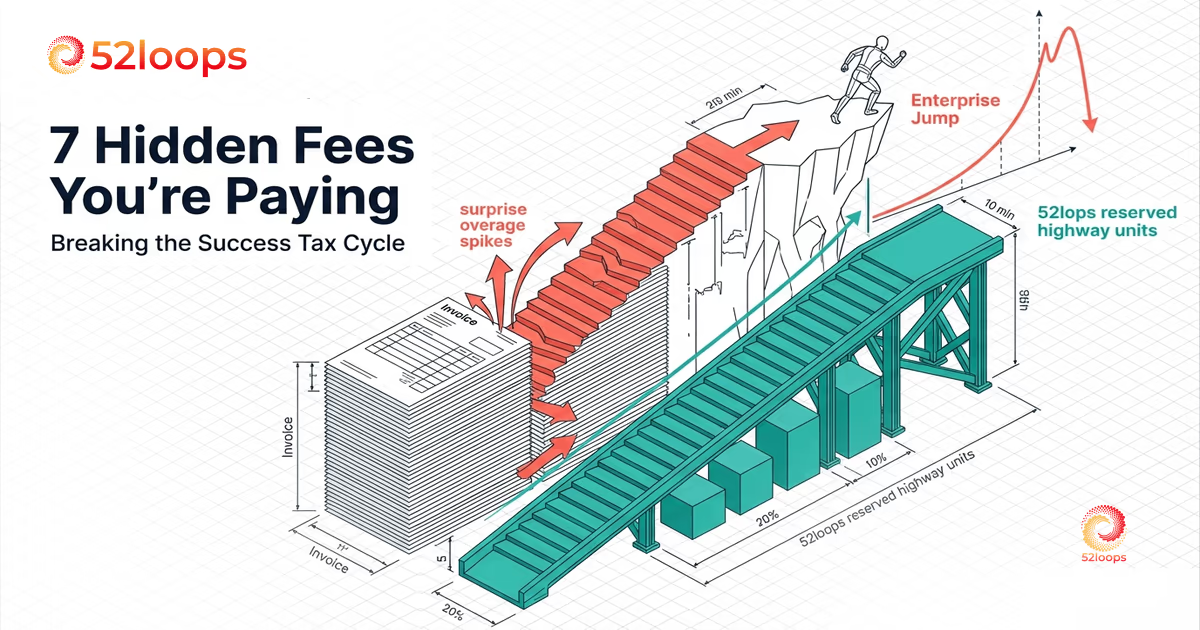
This isn’t a failure of your accounting. It’s a fundamental feature of the legacy video hosting business model. At 52loops, we call this the “Success Tax.” It’s a calculated strategy used by legacy giants to capture your margins as you scale. They hook you with low entry prices, then trigger buried costs, artificial limits, and technical “cliffs” the moment your audience starts watching.
If you’re currently evaluating a “free” or “low cost” host, you must look past the landing page. Here is a deep dive into the seven hidden fees you’re almost certain paying right now, and why they’re costing you more than just money.
In this guide, we break down the 7 fees they don’t advertise: 1. Bandwidth Overage “Success Taxes”, 2. Per Video Limits, 3. Transcoding Fees, 4. Seat/User Costs, 5. Analytics Paywalls, 6. Storage Cliffs, and 7. Privacy Add-ons. This is the only video platform pricing comparison you need to read before committing your infrastructure.
1. The Success Tax (Bandwidth Overages)
Bandwidth is the currency of the internet, but in the world of video hosting, it’s used as a penalty for being popular. Legacy platforms like Wistia and Vimeo typically cap their self serve plans at 1TB or 2TB of data transfer. For a detailed comparison of Vimeo’s bandwidth model against reserved capacity, see our 52loops vs. Vimeo comparison.
On the surface, 1TB sounds like a generous allotment. However, the technical reality of professional video is much more unforgiving. A single hour of 1080p video, encoded at a standard 5Mbps bitrate, consumes approximately 2.2GB per viewer. If you’ve a course module that 450 students watch in a single month, that one module has already exhausted 1TB of bandwidth.
According to Wistia’s 2026 pricing guidelines, their “Plus” plan includes just 1TB of bandwidth. Once you cross this threshold, you’re automatically billed at an overage rate that can reach $0.25 per GB. These video bandwidth overage costs are the primary driver of invoice anxiety. To put this in perspective: the Cloudflare Bandwidth Alliance has driven raw egress costs to near zero for the rest of the industry. Legacy hosts are marking up these costs by 500%.
Your successful launch should be a moment of celebration, not a trigger for an automated “Invoice Anxiety” event that eats your profit margins.
2. Artificial Scarcity (Per Video Limits)
There is no technical requirement to limit the number of video files in a hosting account. Storage is a commodity. Amazon S3 standard storage costs approximately $0.023 per GB. Storing a 5GB 1080p master file costs less than 12 cents per month.
Yet, video hosting platforms create artificial scarcity to force you onto more expensive tiers. If you’re a course creator with 12 modules, you can’t stay on a starter plan that limits you to 10 videos. You’re pushed to a $79/month tier not because of infrastructure costs, but because of a line of code designed to stop your 11th upload. Many founders search for unlimited video hosting plans only to find that these “unlimited” claims are often restricted by buried management taxes.
This is a “Management Tax.” You’re paying for the privilege of seeing a larger list of files in your own dashboard, despite the storage costs being negligible. It forces founders into a cycle of deleting old, valuable content just to stay under an arbitrary cap.
3. The Transcoding Tax
Transcoding is the process of converting your high quality master file into multiple resolutions for mobile and desktop. For course creators, the delivery resolution decision also shapes your bandwidth costs directly, and 1080p is the rational ceiling for most course libraries. Some providers bill you per minute of video processed. It’s the tax you pay for the privilege of having your video work on your customers’ devices.
If you iterate on your content, fixing a typo in a slide or re-recording a segment, you pay this tax every time you hit Save. At $0.05 per output codec per minute, a 50 video library can accrue hundreds of dollars in processing fees before a single viewer clicks Play. If you re-upload a video to fix a typo, you pay the tax again. You’re paying them to do the same job twice.
At 52loops, we believe infrastructure should handle processing as a standard utility. You’re building a business, not a video editing studio. Your infrastructure should adapt to your iteration, not penalize it. Efficiency is our stability, and we pass those architectural savings directly to you.
4. The Collaboration Tax (Seat Limits)
Your infrastructure should scale with your audience, not with the size of your internal payroll. Yet, platforms like Vimeo restrict you to a single user “seat” on lower plans.
The moment you hire a virtual assistant to help with uploads or a developer to integrate the video player into your SaaS product, you’re hit with a “Collaboration Tax.” To give a team member their own login, you’re often forced to upgrade to a “Team” or “Business” plan, even if your video traffic remains the same.
This model treats “collaboration” as a premium feature rather than a professional necessity. It introduces friction into your operations, forcing team members to share passwords or delaying work because the account owner is unavailable. Platforms built around sales teams compound this: Vidyard alternatives for small teams compares how per-seat pricing architecture affects teams whose job is content delivery, not sales prospecting.
5. Analytics Paywalls (The Information Tax)
In a digital business, data is the primary driver of improvement. You need to know which parts of your video students are skipping, where engagement drops off, and whether your videos are converting viewers.
Legacy hosts show you “Number of Plays” for free, but hide individual engagement heatmaps and conversion data behind a paywall. It’s your data, generated by your students, watching your content. Yet they hold it hostage.
This is an Information Tax. If the metrics come from your infrastructure, you should own them.
6. The Storage Upgrade Cliff
Some platforms offer enticing “Lifetime Storage” limits, but these often lead to a “Storage Upgrade Cliff.” A plan might offer 7TB of total storage, which seems massive at the start.
But as your business evolves, as you record more webinars and more product demos, that library grows. Once you hit that 7TB mark, it doesn’t matter if your videos are getting 5 views or 5,000. You’re forced into an Enterprise tier.
You’re penalized for the cumulative volume of your work. This creates an environment where founders are constantly auditing their assets to avoid a massive billing jump, rather than focusing on creating new value.
7. The Privacy Tax (Security Add-ons)
Domain locking, password protection, and custom branding are the foundations of professional video hosting. They’re not “Pro” features.
However, many “affordable” hosts treat these as premium add-ons. They hook you with a low cost per GB, then apply a “Privacy Tax” when you want to ensure your intellectual property isn’t being shared on public social networks. When you need security, it shouldn’t be hidden behind an upgrade gate. Security should be the baseline of a professional infrastructure, not an upsell.
The Psychology of Invoice Anxiety
Beyond the monetary cost, these hidden fees create a psychological burden we call Invoice Anxiety.
When your billing is usage based, every success feels like a potential liability. You hesitate before launching a new marketing campaign because you “are not sure” if your hosting bill can handle the traffic. You audit your library to delete old videos because you’re “approaching a limit.”
This is the opposite of a growth mindset. It’s a scarcity mindset enforced by your infrastructure provider.
The Solution: The Infrastructure Anchor
Video hosting doesn’t have to be a source of stress. The reason the current model feels unstable is that it’s built on Variable Risk. You’re hoping that you don’t grow too fast and trigger a bill you haven’t budgeted for.
We provide Reserved Capacity.
Think of 52loops as a professional Mobile Data Plan for your business. Instead of playing the “catch the overage” game, you secure a Highway Unit . This is a dedicated slice of infrastructure that belongs to you.
- Predictable Costs: You pay for the pipe, not every drop of water. $20 means $20.
- 20% Growth Buffer: If you have a viral launch and your traffic spikes, we provide a buffer. We don’t charge overages. We simply notify you that your capacity needs have shifted and adjust for the next cycle. This is why we built the Growth Buffer as a structural feature, not a marketing gimmick. Our philosophy, why growth should feel like celebration, not a tax event, is explored in our article on why we built a “Growth Buffer” instead of a “Success Penalty”.
- Zero Egress Architecture: Built on a Cloudflare backed backbone that eliminates the hidden costs of data delivery.
- Inclusive Privacy: Domain locking, unlimited video counts, and full analytics are part of the infrastructure, not the “Plus” plan.
The “Success Tax” is a relic of an era when bandwidth was scarce and server time was expensive. In 2026, those costs have dropped, but the pricing models of dominant platforms have remained stuck in the past.
It’s time to stop paying a tax on your own growth. It’s time to move your videos to an Infrastructure Anchor that celebrates your success instead of billing for it.
Frequently Asked Questions
It's the penalty legacy platforms charge you for doing exactly what you set out to do—succeed.
When your video goes viral or your message reaches a massive audience, traditional hosts see that traffic as a "liability" or a cost to be recovered. They trigger automated overage fees or force you onto enterprise plans mid-month, effectively taxing your growth. At 52loops, we view that same traffic as a signal to be amplified, not a billable event.
I'm not a fan of hard-stopping a business mid-stride. I've designed 52loops to be flexible so your "signal" stays live even during growth spurts.
**For Bandwidth Spikes (Occasional Bursts ):** If a video goes viral or you have a high-traffic launch, don't worry. We allow for Occasional Bursts where your usage can spike without immediate penalty. We don't throttle your videos during these moments.
**For Sustained Growth (Stacking Units ):** If your usage consistently stays above your current allowance, it's a sign your business has found its resonance . You can simply add another Highway Unit to increase your capacity (Storage, Bandwidth, and Videos) linearly.
**The Growth Buffer :** If you do hit your hard limits mid-month, the platform automatically adds the next Highway Unit to keep things stable. I'll cover the cost of that additional capacity for the rest of your current billing cycle. You won't see the new rate until your next scheduled payment. It's my way of celebrating your growth instead of taxing it.