
A course creator builds a library over two years. By month 24, the library holds 50,000 minutes of video. Students watch 100,000 minutes per month. The infrastructure is working. Enrollment is steady.
Then the Cloudflare Stream bill arrives.
Storage: 50,000 minutes at $5 per 1,000 minutes = $250. Delivery: 100,000 minutes at $1 per 1,000 minutes = $100. Total for the month: $350. Not because anything broke. Because the library grew and students watched it.
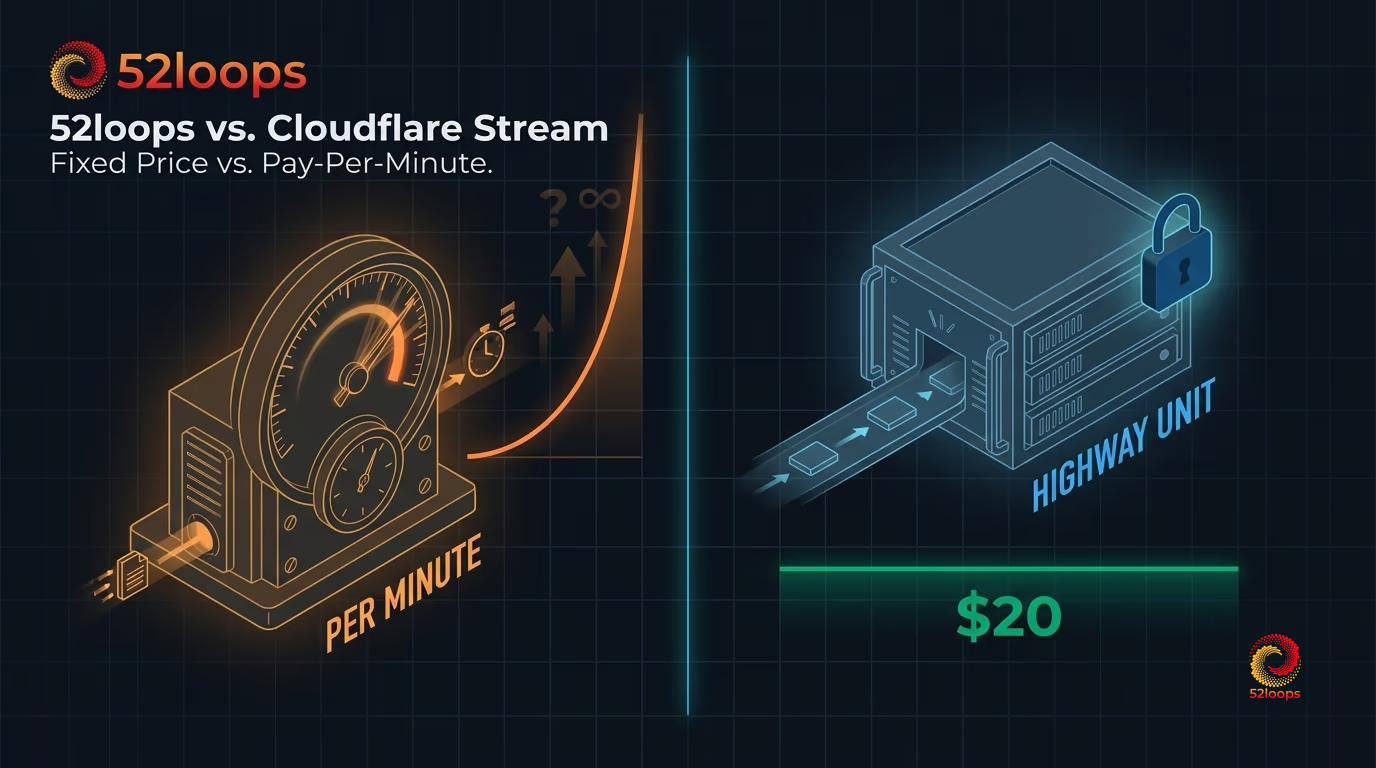
The same usage on 52loops costs $20.
That gap is not a rounding error. It is the structural difference between pay-per-minute infrastructure and reserved-capacity infrastructure. What follows covers how Cloudflare Stream pricing actually works, where that model creates problems for course operators and training teams, and what fixed-capacity pricing looks like at the same scale.
TL;DR: The Short Answer
Cloudflare Stream is a developer-oriented video API. Its pay-per-minute pricing model charges per minute stored and per minute delivered, with no base price and no ceiling. The model is transparent, but it scales with usage in ways that are difficult to plan around.
52loops is managed video hosting with fixed price billing, built on a reserved-capacity model . You pay a flat monthly rate for a defined block of bandwidth and storage. Your hosting cost is settled before the month starts, regardless of how much students watch.
At a Glance
| 52loops | Cloudflare Stream | |
|---|---|---|
| Pricing model | Fixed monthly (Highway Units) | Per-minute stored + per-minute delivered |
| Base price | $20/unit | $0 base, fully metered |
| Storage cost | 100 GB included per unit | $5 per 1,000 minutes stored/month |
| Delivery cost | 1 TB bandwidth included per unit | $1 per 1,000 minutes delivered |
| Monthly cost predictability | Known before the month starts | Known after the month ends |
| Traffic spike handling | Growth Buffer included | Bill scales linearly with views |
| Player | Built-in, branded | Stream Player SDK, requires implementation |
| No-code setup | Yes, dashboard upload | No, requires API integration |
| Target user | Operators and course teams | Developers building video into applications |
How Cloudflare Stream Pricing Actually Works
Cloudflare Stream’s product page and pricing documentation list two line items. Storage: $5 per 1,000 minutes stored per month. Delivery: $1 per 1,000 minutes delivered. No minimum charge. No monthly subscription. Stored video accrues a cost each month it sits in the library. Each view generates a charge at the point of delivery.
This structure is deliberate. Cloudflare Stream is built for developers who need a programmable video API, not operators who need a managed platform. The metered model suits teams where video is embedded in custom software and usage patterns are controlled by application logic.
For course creators and training teams, the pattern is different. A library grows as new content gets added. Delivery volume tracks enrollment and engagement, both of which the operator is trying to increase. The Cloudflare Stream pricing model treats growth as a cost event. Every time the library works well, the bill goes up.
The Per-Minute Storage Problem
Storage charges on metered platforms compound. A video uploaded today costs money every month it sits in the library. For a course business where content has a long shelf life, this is not a temporary cost. It is a permanent one that grows with every upload.
Take a library adding 500 minutes of new content per month. After 12 months, the library holds 6,000 minutes. Storage cost: $30 per month. After 24 months, it holds 12,000 minutes. Storage cost: $60 per month. The hosting bill grows even if enrollment is completely flat.
On fixed-capacity infrastructure, the storage cost does not change month to month unless you add a unit. The library can grow within its allocated storage without triggering a new charge.
The Billing Math: A Course Library at Scale
The numbers below come directly from Cloudflare Stream’s published pricing, using the documented rate card as-is.
The scenario: A training team runs a mature course library. The library contains 50,000 minutes of stored video. Students collectively watch 100,000 minutes per month.
Cloudflare Stream cost breakdown:
| Line item | Calculation | Monthly cost |
|---|---|---|
| Storage (50,000 min / 1,000 x $5) | 50,000 minutes in library | $250.00 |
| Delivery (100,000 min / 1,000 x $1) | 100,000 minutes watched by students | $100.00 |
| Total | $350.00 |
52loops cost breakdown:
| Line item | Calculation | Monthly cost |
|---|---|---|
| 1 Highway Unit (1 TB bandwidth, 100 GB storage) | Covers the full usage scenario | $20.00 |
| Total | $20.00 |
For a course library with 50,000 minutes stored and 100,000 minutes delivered monthly, Cloudflare Stream costs $350 per month. 52loops covers the same usage for $20. The math is simple. The problem is that on Cloudflare Stream, you only see that number after the month ends.
A note on unit conversion: 50,000 minutes of video at standard 1080p bitrates occupies roughly 60-70 GB. This fits within a single Highway Unit ’s 100 GB storage allocation. The 100,000 monthly delivery minutes represent approximately 500 GB of bandwidth, well within the 1 TB bandwidth allocation.
The Unpredictability Problem
The cost gap is significant. The timing issue is worse.
Professional operators plan infrastructure costs before the month starts. A team that knows it will spend $350 on video hosting can budget for it, factor it into subscription pricing, and account for it in unit economics. That team has a stable line item.
A team on metered infrastructure cannot know its video hosting cost in advance. It can estimate based on last month’s usage. That estimate fails whenever student engagement increases, a new cohort enrolls, or a module circulates widely. Each of these is a business success. Each generates an unexpected cost event.
Invoice Anxiety is the operational consequence of metered infrastructure. The bill is not wrong. The model is just incompatible with how operators run businesses. Cloudflare Stream billing is unpredictable not because Cloudflare miscalculates it, but because the inputs that drive the bill are outside the operator's control.A platform with no overage charges resolves this at the model level. Knowing your bill on day one versus day thirty is not a minor convenience. It is the difference between infrastructure that supports planning and infrastructure that disrupts it.
What Makes the Variance Hard to Model
Cloudflare Stream’s delivery cost scales directly with minutes watched. Monthly watch time is shaped by enrollment numbers, average engagement per student, the number of active courses in a given month, and any promotional period where a course is offered free or discounted.
An operator can model the central case reasonably well. Modeling the variance is harder. A promotion that doubles watch time for a single month doubles the delivery cost. There is no ceiling. There is no buffer period. The bill reflects exactly what happened.
That accuracy is appropriate for some use cases. For course operators whose success depends on students watching more video, it is the wrong structure.
For a broader look at how hidden costs accumulate across video platforms, 7 Hidden Fees in Affordable Video Hosting covers the full pattern.
Where Cloudflare Stream Excels
Cloudflare Stream has genuine strengths. Dismissing them would make this comparison useless to anyone who has already done their own research.
Developer infrastructure. Cloudflare Stream provides a well-documented API for uploading, transcoding, and delivering video. For engineering teams building video into custom applications, the integration paths are solid and the Stream API fits naturally into Cloudflare’s broader developer platform, including Workers, Pages, and R2.
Low-volume cost efficiency. If a team hosts a small number of videos with infrequent viewing, the metered model can cost less than a fixed monthly subscription. At low usage volumes, paying nothing at the base level is mathematically favorable. The crossover point varies by usage mix, but operators in early stages with occasional viewers benefit from zero base cost.
Cloudflare’s network. Cloudflare operates one of the largest content delivery networks in the world. Video delivered through Stream benefits from that global infrastructure, including low-latency edge delivery and high availability. The network quality is a genuine asset.
API-level control. Teams that need to build custom video workflows, trigger processing via webhooks, or integrate video into existing software pipelines get real value from the API-first architecture. Cloudflare Stream exposes controls that a managed platform intentionally abstracts away.
How 52loops Is Different
52loops is built on a Highway Unit model. Each unit provides 1 TB of bandwidth and 100 GB of storage for $20 per month. The player, domain-locking, access controls, and global edge delivery are included in that price. There are no add-ons charged separately.
Think of it like a mobile data plan. You buy a defined block of capacity at the start of the billing cycle. You use it throughout the month. If usage stays within that block, your bill does not change. You can look at your dashboard on day one and know exactly what you will pay on day thirty.
The Growth Buffer handles spikes. If usage crosses the unit ceiling mid-month, the platform extends capacity for the rest of the cycle at no charge. You are notified and can decide whether to add a unit for the next cycle, depending on whether the growth is sustained or a one-time event. The full mechanics are covered in Why We Built the Growth Buffer, Not a Success Penalty.
The Architecture Behind Fixed Pricing
52loops runs on Cloudflare’s global edge network with a zero-egress architecture. The pricing is fixed because the underlying cost structure is fixed. Cloudflare’s Bandwidth Alliance eliminates the egress fees that make per-GB delivery pricing necessary on most platforms. The result is infrastructure where fixed-capacity pricing is operationally sustainable.
Cloudflare Stream does not apply this architecture to eliminate its own delivery charges. That is a product design choice, not a technical limitation.
For a closer look at how billing models affect real costs over time, 2026 Guide: Video Hosting Overages and How to Avoid Them runs through the math across several scenarios.
Pricing: Cloudflare Stream vs. 52loops
The table below models three common usage scenarios using published rates from both platforms. The goal is to identify where each pricing model is actually cheaper, not to pick a winner.
Scenario 1: Small library, early stage
- Stored: 1,000 minutes (roughly 6-7 hours of content)
- Monthly delivery: 5,000 minutes
| Platform | Storage | Delivery | Total/month |
|---|---|---|---|
| Cloudflare Stream | $5.00 | $5.00 | $10.00 |
| 52loops | Included | Included | $20.00 |
Cloudflare Stream is cheaper here. The metered model favors low-volume operators with infrequent viewing.
Scenario 2: Growing library, active student base
- Stored: 10,000 minutes
- Monthly delivery: 30,000 minutes
| Platform | Storage | Delivery | Total/month |
|---|---|---|---|
| Cloudflare Stream | $50.00 | $30.00 | $80.00 |
| 52loops | Included | Included | $20.00 |
The crossover is somewhere between scenarios 1 and 2, depending on the storage-to-delivery mix. Past that point, the fixed model is cheaper every month without exception.
Scenario 3: Mature library, established course business
- Stored: 50,000 minutes
- Monthly delivery: 100,000 minutes
| Platform | Storage | Delivery | Total/month |
|---|---|---|---|
| Cloudflare Stream | $250.00 | $100.00 | $350.00 |
| 52loops | Included | Included | $20.00 |
At this scale, the gap is $330 per month. The metered model compounds as the library matures.
The Crossover Point
At Cloudflare Stream’s published rates, the monthly cost reaches $20 (one 52loops unit) at roughly 4,000 minutes stored with no delivery, 20,000 minutes delivered with no storage, or a combination of both. Most course businesses cross that threshold within the first year of operation. After the crossing, every additional month on pay-per-minute video hosting costs more than fixed-capacity pricing would have. If you are looking for a Cloudflare Stream alternative with predictable billing, this is the fundamental trade-off to understand.
Who Should Use Each Platform
Cloudflare Stream is the right fit when:
- An engineering team is building video directly into a custom application
- Usage is low and infrequent, making zero base cost favorable
- API-level control over the transcoding and delivery pipeline is required
- Video is one component within a broader Cloudflare developer platform deployment
- Metered cost aligns with per-user billing in your own product
52loops is the right fit when:
- You operate a course library or training platform where content accumulates over time
- Your hosting cost needs to be known before the month starts
- You want a complete platform (player, access controls, analytics) without engineering setup
- Your student base is growing and delivery volume scales with enrollment
- Budget predictability is a requirement, not a preference
For operators comparing this pattern across more platforms, 52loops vs. Mux covers the same operator-vs-developer distinction in detail. It is a recurring dynamic in the video hosting category.
The same pattern appears across a wider set of tools in Vidyard Alternatives for Small Teams Without Enterprise Bloat.
Video hosting should be the most predictable line item on your infrastructure budget. Fixed price video hosting and pay-per-minute billing are both real models. Cloudflare Stream is a capable product. The question is which model fits how you actually run your business.
For operators who plan costs before the month starts, 52loops pricing shows how Highway Units work in practice.
Frequently Asked Questions
A Highway Unit is the fundamental building block of your 52loops account. Instead of forcing you into restrictive tiers, we provide you with a fixed bucket of resources.
Every single feature, including our high-performance Player, Global CDN, ad-free hosting, and referer protection—is included in every Highway Unit.
Each unit provides a base of: - 1TB Bandwidth (Upgraded to 2TB for Founding members ) - 100GB Storage - 100 Video Slots
As your business grows, you simply add more units to increase these limits. See How Stacking Units works .
It's the penalty legacy platforms charge you for doing exactly what you set out to do—succeed.
When your video goes viral or your message reaches a massive audience, traditional hosts see that traffic as a "liability" or a cost to be recovered. They trigger automated overage fees or force you onto enterprise plans mid-month, effectively taxing your growth. At 52loops, we view that same traffic as a signal to be amplified, not a billable event.
The "Success Tax " is one of the things I hate most about legacy platforms. If a video goes viral, you shouldn't get a terrifying bill.
At 52loops, if you genuinely cross your unit limits mid-month, the system automatically adds an additional "Highway Unit " to your account to keep things stable. I cover the cost of that upgrade for the rest of your current billing cycle.
Example: Imagine you have 1 Highway Unit (1TB Bandwidth). On the 15th of the month, a video goes viral and you hit 2.5TB. 1. We automatically add a 3rd Unit (increasing your limit to 3TB). 2. Your videos keep playing without interruption. 3. You pay $0 extra for that 3rd unit for the remainder of the month. 4. At the start of the next cycle, you can choose to keep the 3rd unit if your growth is permanent, or drop back to 1 unit if it was just a temporary spike.
Legacy hosts often wait until the end of the month to "tax" you for traffic you've already used. At 52loops, we never bill you for past usage. If you exceed your limit, our Growth Buffer covers you for the rest of the cycle at no cost. You only ever decide to move to a higher capacity for *future* billing cycles.
Invoice Anxiety is the psychological burden felt by business owners when using usage-based billing models. It occurs when success—like a viral video or a successful product launch—leads to unpredictable and often massive overage charges.
Instead of celebrating a win, you're stuck doing damage control on your bank account. We built 52loops specifically to eliminate this anxiety by using Reserved Capacity instead of metered billing.