
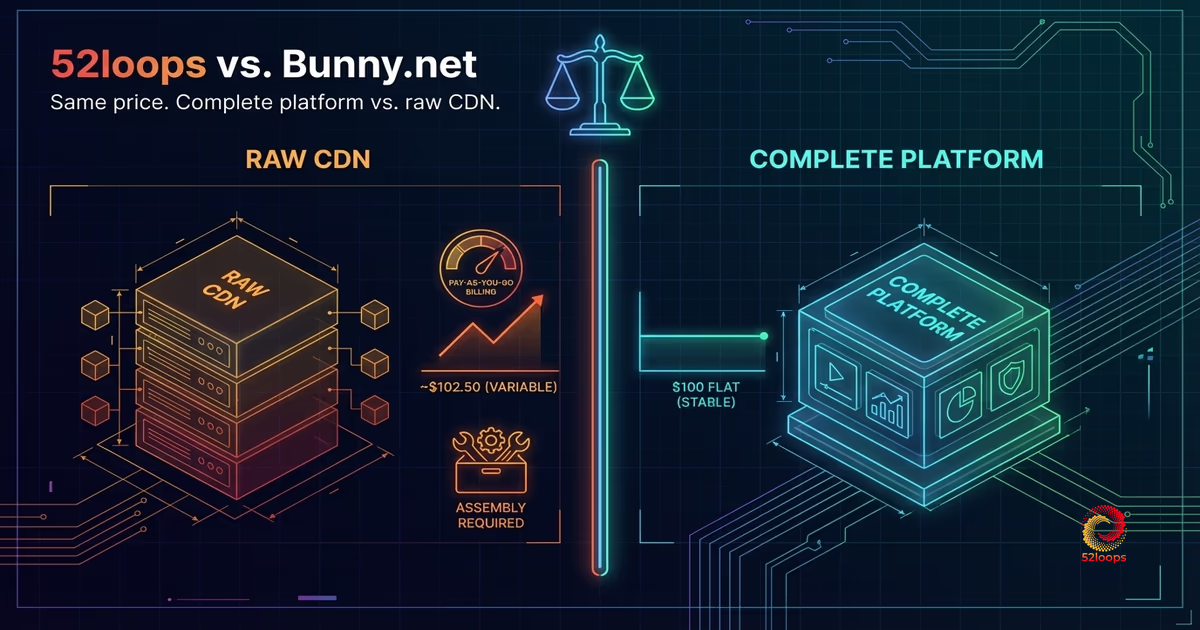
One number worth anchoring before you read further: 10,000 GB of video delivery on Bunny.net costs approximately $102.50, based on Bunny.net’s published Stream pricing. This breaks down to $100 in CDN delivery at $0.01 per GB plus $2.50 in storage for 500 GB of hosted content at $0.005 per GB per month. That same month on 52loops costs $100, flat, as an early adopter with 2TB per Highway Unit at $20. The price is nearly the same. What is not the same is what you get for it.
10,000 GB is not a theoretical extreme. A course platform with 500 students watching 20 GB of content each per month reaches that number. On Bunny.net, you get raw CDN delivery. On 52loops, you get a complete platform: a domain-locked player, privacy-first view and bandwidth analytics, HLS adaptive bitrate, and a Growth Buffer that absorbs mid-month spikes at no extra cost. No invoice arrives after the month closes. No sales call is required.
The question this article answers is not whether Bunny.net has good infrastructure. It does. The question is whether a pay-as-you-go CDN suits a business that needs video hosting to be a settled, predictable cost. If your billing model creates anxiety every time viewership grows, you have the wrong tool. The 2026 guide to video hosting overages covers how this pattern plays out across the industry.
TL;DR: The Short Answer
The short answer: 52loops is a complete video platform with flat-rate billing. Bunny.net is a raw CDN with pay-as-you-go pricing. Choose 52loops if you need predictable costs and a working platform out of the box. Choose Bunny.net if you have engineering capacity and want full API control over a custom-built stack.
Bunny.net is a capable, transparent CDN service. It suits developers who want raw delivery infrastructure and are prepared to assemble a full video stack themselves. For course creators, SaaS teams, and training operations who need a complete video platform with predictable billing, the pay-as-you-go model introduces risk that reserved capacity eliminates.
| Bunny.net Stream | 52loops | |
|---|---|---|
| Primary audience | Developers, media archives, cost-sensitive builders | SaaS teams, course creators, training ops |
| Pricing model | Pay-as-you-go ($0.01/GB delivery) | Linear Scaling per Highway Unit |
| Monthly cap | None | Fixed per Highway Unit (2TB, early adopter) |
| Growth penalty | Unbounded bill with no ceiling | Growth Buffer absorbed at no cost during the month |
| CDN edge coverage | 120+ PoPs | 330+ Cloudflare PoPs (Bandwidth Alliance) |
| Built-in player | Basic, requires configuration | Domain-locked, privacy-first |
| Analytics | Basic view/bandwidth stats | View/bandwidth stats, privacy-first, no third-party tracking |
| Entry cost | Usage-based (no flat floor) | $20/month (1 Highway Unit) |
Where Bunny.net Excels (The Honest Assessment)
Bunny.net is a genuinely strong CDN, and that deserves to be said plainly before any comparison.
Their global network covers over 120 points of presence across Europe, North America, Asia-Pacific, and Latin America. For static file delivery, media archives, and high-volume downloads where engineering control matters more than a turnkey product, Bunny.net is a rational, cost-transparent choice.
Their pricing is honest. Based on Bunny.net’s published pricing, Stream delivery runs at $0.01/GB, storage at $0.005/GB per month, and encoding is charged per minute of content processed. There are no hidden tiers. No surprise fees buried in a fair-use clause. The calculator on their pricing page is accurate and readable. That transparency is a genuine strength.
For a developer building a custom video pipeline who wants full API control over raw delivery infrastructure, Bunny.net delivers at a competitive per-GB rate.
The limitations show up when you ask what comes next.
The Assembly Problem: What Bunny.net Does Not Include
Bunny Stream is infrastructure. It is not a product.
The per-GB pricing covers delivery. It does not cover the full stack a working video platform requires. To build a production-ready video product on top of Bunny Stream, you typically need to assemble several additional layers.
Player. Bunny provides a basic embedded player, but configuring it for domain-locking, custom branding, and consistent cross-device behavior requires engineering time. Third-party player libraries, such as Video.js or Plyr, add configuration overhead and ongoing maintenance.
Analytics. Bunny’s built-in analytics covers view counts and bandwidth consumed. It does not provide viewer engagement data, chapter completion tracking, or the behavioral signals a course platform depends on to measure content effectiveness.
Privacy and tracking. Bunny’s player integrates with standard analytics stacks, which typically means third-party scripts running on your viewer’s browser. For businesses with privacy obligations (GDPR, HIPAA-adjacent policies, or internal data governance), this requires auditing each component in the stack.
Customer success. Bunny.net operates as a self-serve infrastructure service. There is no dedicated support layer for non-technical operators. Troubleshooting delivery issues, encoding failures, or player misconfigurations falls to your own engineering team.
The per-GB rate is real. The total cost of ownership, including the engineering hours required to wire a complete video product together, is less visible at first glance. Delivery egress charges routinely account for 10-15% of total cloud infrastructure bills, and 62% of organizations exceeded their cloud storage budgets in 2024, up from 53% the prior year, according to Wasabi’s 2025 Global Cloud Storage Index (n=1,600, Vanson Bourne). That gap is documented in more detail in 7 hidden fees in affordable video hosting.
The Why We Built Growth Buffer (Not Success Penalty) article explains how 52loops designed its billing model specifically around this assembly problem.
The Billing Math: What a Traffic Spike Actually Costs
For a direct comparison, here is the billing math on a realistic traffic scenario. Source: bunny.net/pricing/stream/. A 2025 analysis of CDN pricing models found that pay-as-you-go delivery offers maximum flexibility but warns of “potential for surprise costs during traffic spikes,” citing a Forrester survey in which 41% of CDN customers faced unanticipated surcharges during high-traffic events.
Scenario: A course platform with 500 students, each consuming 20 GB of video per month. A launch event drives an additional 5,000 GB of delivery in a single week.
Total delivery for the month: 10,000 GB (5,000 GB baseline plus 5,000 GB spike).
Bunny.net Stream bill:
- CDN delivery: 10,000 GB x $0.01 = $100.00
- Storage (500 GB of content): 500 GB x $0.005 = $2.50
- Encoding (one-time, not counted): varies per minute of content
- Total: approximately $102.50 for the month
52loops bill (early adopter: 2TB per Highway Unit):
- 1 Highway Unit covers 2TB of delivery and 100GB of storage for $20/month
- A 10TB delivery month requires 5 Highway Units at $100/month
- The Growth Buffer absorbs mid-month spikes internally. You pay only for your committed units during that cycle. Capacity adjusts at the next cycle if growth is sustained.
- At a stable 10TB/month baseline, the cost is $100/month. At 2TB/month with a spike, you pay $20.
- Total: $100/month flat, includes player, analytics, domain-locking, and Growth Buffer
The raw delivery cost at scale is nearly identical. What differs is certainty and scope. Bunny.net’s $102.50 covers CDN delivery only. The bill arrives after the month closes. You cannot undo delivery costs that have already run. 52loops’ $100 covers the complete platform, and you knew the number before the month began.
For a 2TB-per-month operation that spikes to 10TB once, Bunny.net charges $102.50 in the spike month with no warning. 52loops charges $20, with the spike absorbed. The Success Tax is most visible not in the total number but in the timing: the invoice arrives after the damage is done.
Professionals budget infrastructure in advance. Pay-as-you-go is a reasonable model for experiments. It is a liability for operations.
Pricing: Bunny.net vs. 52loops
Bunny.net has no flat monthly floor for Stream. Every gigabyte of delivery is billed. For a platform with predictable, steady traffic, the per-GB rate can appear low. For a platform with variable traffic, seasonal spikes, or any event-driven delivery pattern, the invoice is unknown until the month closes. In data-intensive workloads, delivery egress costs can exceed storage costs by 3 to 5 times, making the line-item gap between estimated and actual spend a recurring budget problem.
52loops pricing is linear. Think of it like a mobile data plan with a dedicated data bucket: you buy a specific amount of reserved capacity that is entirely yours. Each Highway Unit adds:
- 2TB of monthly bandwidth (early adopter rate)
- 100GB of high-performance storage
- $20/month flat
There are no encoding add-ons. No player fees. No separate analytics tier. The full platform, including the domain-locked player, HLS adaptive bitrate delivery, and privacy-first analytics, is included in the Highway Unit price.
| Monthly delivery | Bunny.net estimate | 52loops (Highway Units, early adopter) |
|---|---|---|
| 2TB (2,000 GB) | ~$20 CDN + storage | $20 (1 unit, flat, complete platform) |
| 4TB (4,000 GB) | ~$40 CDN + storage | $40 (2 units, flat, complete platform) |
| 10TB (10,000 GB) | ~$102.50 CDN + storage | $100 (5 units, flat, complete platform) |
| Spike month (+5,000 GB) | Bill increases proportionally | Growth Buffer absorbs, no overage |
At equivalent delivery volumes, the per-TB cost is comparable. The difference is scope and certainty. Bunny.net’s number covers CDN delivery only. 52loops’ number covers the complete platform. And on Bunny.net, the invoice is unknown until the month closes. On 52loops, you know the number before the month begins. The Growth Buffer advantage is most material during spike events, precisely the moments when invoice uncertainty causes the most operational disruption.
Complete Platform vs. Raw CDN: What You Are Actually Buying
The core distinction in this comparison is not price per gigabyte. It is scope.
Bunny.net sells delivery infrastructure. 52loops sells a complete video platform. The following table reflects what each option includes by default.
| Feature | Bunny.net Stream | 52loops |
|---|---|---|
| Pricing model | Pay-as-you-go ($0.01/GB) | Flat rate per Highway Unit |
| Monthly cap | None | Fixed per unit |
| Growth spike protection | None (bill continues) | Growth Buffer, no overage invoice |
| Built-in player | Basic embedded player | Domain-locked, privacy-first player |
| HLS adaptive bitrate | Yes | Yes |
| Input formats accepted | Multiple | MP4, MOV, MKV |
| Player analytics | Basic view/bandwidth stats | Basic view/bandwidth stats + privacy-first, no third-party tracking |
| Domain locking | Configurable via API | Enforced by default |
| DRM | Available on higher tiers | Planned |
| Customer support | Self-serve/API documentation | Included |
| Engineering required | Significant (full stack assembly) | Minimal (platform is complete) |
| Global edge coverage | 120+ PoPs | 330+ Cloudflare PoPs |
| Zero-Egress architecture | No | Yes (Cloudflare Bandwidth Alliance) |
Bunny.net wins on: API control for developers building fully custom pipelines, and a mature self-serve ecosystem for raw CDN infrastructure work.
52loops wins on: Edge performance (330+ Cloudflare PoPs vs. 120+ Bunny PoPs), zero-egress delivery cost via the Cloudflare Bandwidth Alliance, billing predictability with no overage invoices, complete platform coverage with no assembly required, and privacy-first defaults out of the box.
Who Should Use Each Platform?
Stay with Bunny.net if you:
- Are building a custom video pipeline and need raw CDN infrastructure with full API control
- Serve static files, media archives, or low-frequency downloads where the per-GB rate is the primary concern
- Have an engineering team capable of assembling and maintaining a full player, analytics, and privacy stack
- Run predictable, low-traffic delivery where the variable billing model does not represent material risk. For individual operators, our affordable video hosting for solopreneurs guide explains how to evaluate if a pay-as-you-go model remains viable as you grow.
- Are evaluating multiple CDN-based options. The 52loops vs. Vimeo comparison covers a similar creative-vs-operational tradeoff from a different angle, and 52loops vs. Mux covers the same “raw API vs. complete platform” distinction for another developer-first infrastructure provider
Switch to 52loops if you:
- Run a course platform where enrollment growth directly drives delivery volume and an uncapped bill is a budget risk
- Operate a SaaS product where video is part of core product delivery and infrastructure must be treated as a fixed cost
- Manage internal training operations and need a privacy guarantee, with no third-party tracking on employee or student videos
- Have experienced a spike month on Bunny.net and found the invoice unpredictable relative to your budget
- Need video hosting to be a single, predictable line item rather than a stack of assembled components
- Want a broader view of how platforms stack up: the best video hosting for course creators in 2026 guide covers eight options side by side
How to Migrate from Bunny.net to 52loops
Migrating from Bunny Stream to 52loops does not require a migration project. A single engineer or a non-technical operator can move an entire library in a day.
Step 1: Audit your current library. Use Bunny Stream’s API or dashboard to export a list of your video assets. Document total storage volume and your average monthly delivery consumption over the last three months. Note the peak month in that window.
Step 2: Calculate your Highway Units. Divide your average monthly bandwidth by 2TB per unit (early adopter rate). Round up. A platform consuming 4TB per month needs 2 Highway Units at $40/month. Compare this against your average Bunny.net bill, including your highest spike month in the last year. The comparison across a 12-month window typically makes the cost case clearer than a single average month.
Step 3: Upload to 52loops. Use the 52loops dashboard or bulk upload API to transfer your library. 52loops accepts MP4, MOV, and MKV source files and re-encodes to HLS for adaptive bitrate delivery. You do not need to pre-process or transcode files before upload.
Step 4: Replace embed codes. Swap Bunny Stream’s player embeds for 52loops embed codes in your site, LMS, or application. The 52loops player enforces domain-locking by default. Videos play only on the domains you explicitly authorize, which closes the unauthorized embedding risk without any additional configuration.
Step 5: Verify and wind down Bunny.net. Confirm all content plays correctly in production. Monitor delivery for one billing cycle to validate the Highway Unit calculation. Then close or reduce your Bunny.net account to match only any remaining non-video workloads you want to keep on their CDN.
Video infrastructure should be settled infrastructure. Moving to a reserved-capacity model means your hosting cost becomes one fewer variable to manage, and one more fixed anchor in your operating budget.
Ready to switch? Start with a free trial.
Frequently Asked Questions
A Highway Unit is the fundamental building block of your 52loops account. Instead of forcing you into restrictive tiers, we provide you with a fixed bucket of resources.
Every single feature, including our high-performance Player, Global CDN, ad-free hosting, and referer protection—is included in every Highway Unit.
Each unit provides a base of: - 1TB Bandwidth (Upgraded to 2TB for Founding members ) - 100GB Storage - 100 Video Slots
As your business grows, you simply add more units to increase these limits. See How Stacking Units works .
Instead of complex "Pro" or "Enterprise" tiers where you pay for features you don't need, 52loops scales linearly. Each Highway Unit you add gives you exactly the same predictable capacity.
Example: - 1 Unit: 1TB Bandwidth, 100GB Storage, 100 Videos ($20/mo) - 2 Units: 2TB Bandwidth, 200GB Storage, 200 Videos ($40/mo) - 5 Units: 5TB Bandwidth, 500GB Storage, 500 Videos ($100/mo)
You have the same total freedom and features regardless of whether you have 1 unit or 100.
It's the penalty legacy platforms charge you for doing exactly what you set out to do—succeed.
When your video goes viral or your message reaches a massive audience, traditional hosts see that traffic as a "liability" or a cost to be recovered. They trigger automated overage fees or force you onto enterprise plans mid-month, effectively taxing your growth. At 52loops, we view that same traffic as a signal to be amplified, not a billable event.
The "Success Tax " is one of the things I hate most about legacy platforms. If a video goes viral, you shouldn't get a terrifying bill.
At 52loops, if you genuinely cross your unit limits mid-month, the system automatically adds an additional "Highway Unit " to your account to keep things stable. I cover the cost of that upgrade for the rest of your current billing cycle.
Example: Imagine you have 1 Highway Unit (1TB Bandwidth). On the 15th of the month, a video goes viral and you hit 2.5TB. 1. We automatically add a 3rd Unit (increasing your limit to 3TB). 2. Your videos keep playing without interruption. 3. You pay $0 extra for that 3rd unit for the remainder of the month. 4. At the start of the next cycle, you can choose to keep the 3rd unit if your growth is permanent, or drop back to 1 unit if it was just a temporary spike.
HLS (HTTP Live Streaming) is the delivery standard 52loops uses for all video playback. Instead of sending a single fixed-quality video file, the platform encodes your upload into multiple quality levels (320p, 720p, 1080p) and breaks each into short segments.
The player monitors your viewer's available bandwidth in real time and selects the appropriate quality level automatically. On a fast connection, your viewer gets 1080p. On a mobile connection mid-commute, the player steps down to 720p or 320p to keep playback smooth without buffering.
The practical result is that your video starts faster and stalls less often, regardless of the viewer's network conditions. HLS is the same delivery method used by Netflix and YouTube, and it is supported natively on every modern device and browser.
A CDN (Content Delivery Network) is delivery infrastructure. It moves files from servers to viewers quickly, using a global network of edge nodes. Bunny.net, Cloudflare, and AWS CloudFront are CDNs.
A video platform is a complete product built on top of delivery infrastructure. It includes the player, transcoding pipeline, domain-locking, analytics, and support, assembled and maintained so you do not have to.
52loops is a video platform. It uses a CDN (Cloudflare's global edge network) as part of its infrastructure, but the CDN is one component among several, not the product itself.
The distinction matters for cost estimation. A CDN price covers delivery only. A video platform price covers delivery plus everything required to make delivery work reliably for non-technical operators.