
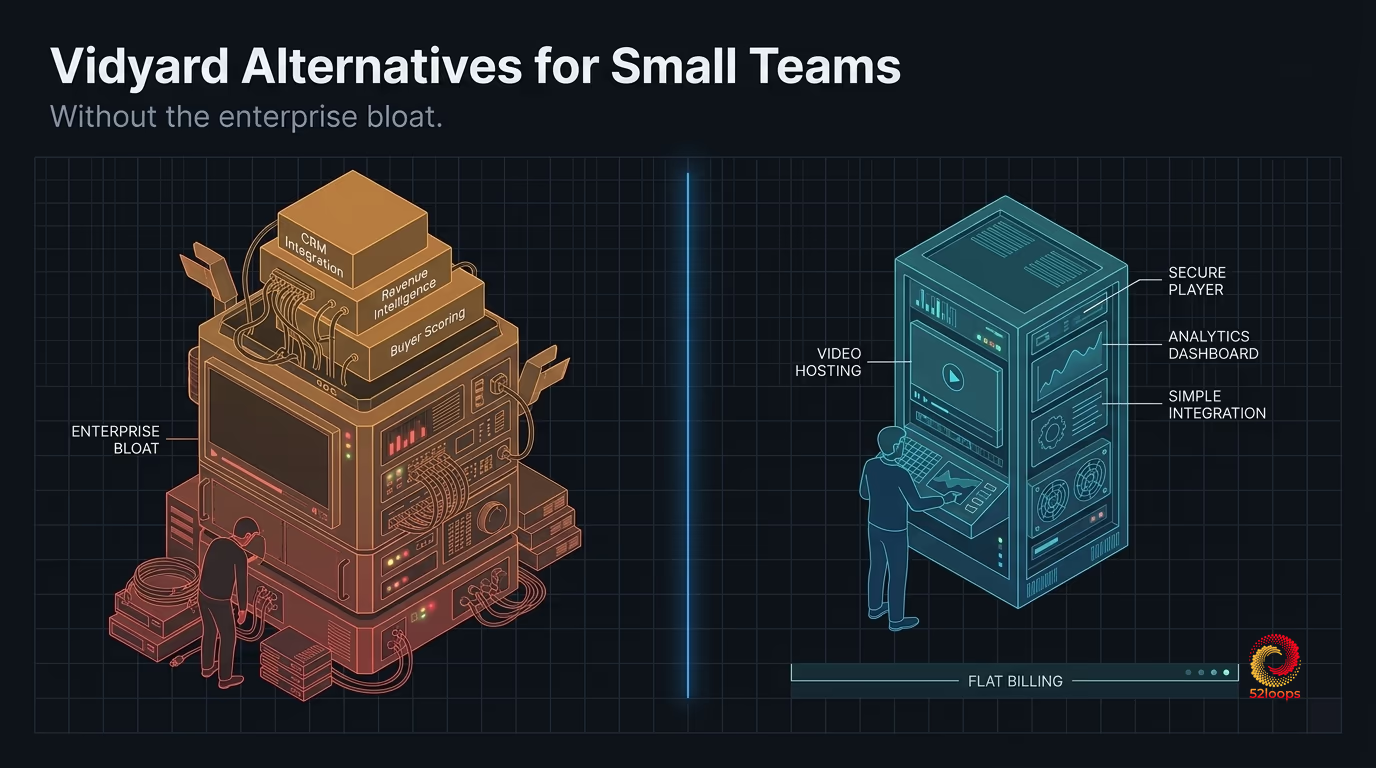
Vidyard is an excellent product for sales teams. It is not designed for hosting course content, training libraries, or SaaS product video. If that is your use case, you are paying for a platform built around features you will never use.
According to Vidyard’s published pricing page, Vidyard Pro costs $80/user/month, billed annually. That is $960 per seat per year. A 3-person team pays $2,880/year. A 5-person training or content team pays $4,800/year, before a single video is hosted.
The features powering that price point, including CRM integration with Salesforce and HubSpot, buyer engagement scoring, and revenue intelligence dashboards, are built for quota-carrying sales reps who track video view data as a pipeline signal. They are not built for the team that needs a reliable player, clean analytics, and domain-locked delivery for a course library.
This article compares five alternatives to Vidyard for small teams whose job is video hosting, not sales enablement: Loom, Wistia, Vimeo, Cloudflare Stream, and 52loops. Each platform is assessed honestly against the use case it was actually designed for.
The best Vidyard alternative for small teams that need video hosting, not sales enablement, is 52loops, with fixed $20/month infrastructure pricing per Highway Unit. For marketing video, Wistia. For creative teams, Vimeo. For async messages, Loom.
TL;DR: Quick Answer
Vidyard is a sales enablement platform. If your team needs video hosting for training, courses, or product delivery, the alternatives below are on the correct shelf. 52loops is the infrastructure-first pick for teams that need reliable delivery without per-seat pricing or sales apparatus.
| Vidyard Pro | Loom Business | Wistia Pro | Vimeo Standard | Cloudflare Stream | 52loops | |
|---|---|---|---|---|---|---|
| Primary use case | Sales enablement | Async messaging | Marketing video | Creative hosting | Developer API | Video infrastructure |
| Pricing model | Per seat | Per seat | Flat tiers | Flat tiers | Pay-as-you-go | Per Highway Unit |
| Entry tier monthly | $80/month (1 seat) | $12.50/month (1 seat) | $79/month flat | $20/month flat | Usage-based | $20/month (1 unit) |
| Entry tier annual | $960/year (1 seat) | $150/year (1 seat) | $948/year flat | $240/year flat | Varies | $240/year flat |
| Per-seat pricing | Yes | Yes | No | No | No | No |
| Video count limit | Unlimited (Pro) | 25 videos (free) | Unlimited (Pro) | Unlimited | Unlimited | Unlimited |
| Setup complexity | High (CRM, analytics) | Low | Medium | Low | High (build everything) | Low |
| Sales features | Full suite | Basic | None | None | None | None |
What Is Vidyard Actually Built For?
Vidyard is a well-executed sales enablement platform. Its strengths are real, and they belong to a specific category of buyer.
Vidyard’s core product allows sales development representatives to record personalized video messages, embed them in outbound emails, and track when a prospect watches. The platform records view duration, replay events, and individual viewer engagement, then pipes that data directly into Salesforce, HubSpot, Outreach, and other sales tooling. A VP of Revenue Operations can see which video messages correlate with pipeline movement. That is a specific, legitimate business function. G2’s category listing for Vidyard classifies it under Sales Engagement and Video Selling, not Video Hosting.
The Free tier on Vidyard supports individual testing, but it includes watermarks and caps video count, making it unsuitable for professional delivery. The Pro tier at $80/user/month removes those constraints and is a defensible price for a revenue-generating SDR using video as an outbound channel. The Enterprise tier requires contacting sales, with no self-serve path to evaluate or commit.
Vidyard is correctly priced for its actual buyer. The problem arises when a course creator, training manager, or SaaS product team searches “video hosting” and lands on Vidyard’s pricing page without a clear signal that they have arrived at a sales tool, not a hosting platform.
Why Small Teams Hit the Wall with Vidyard
The per-seat model is the core structural mismatch. A training library does not require one seat per learner. A SaaS product delivering onboarding video to customers does not need one seat per customer. Vidyard’s pricing architecture assumes a team of individual sales reps, each needing their own recording, tracking, and analytics setup.
That assumption has no analog in a content or product team.
The feature set adds cost that never converts to utility. CRM synchronization, buyer engagement scoring, revenue intelligence, and sales funnel analytics all require setup, configuration, and ongoing maintenance. For a team that will never touch those features, the complexity is a tax on onboarding time. You pay for the configuration overhead and carry unused capabilities on every invoice.
Vidyard has no designed path for course hosting, training libraries, or product onboarding video. The player is built for single-send video messages embedded in sales emails, not for structured libraries organized by module or curriculum. Uploading 200 training videos to Vidyard is technically possible. It is not what the product was built to support.
The sales-led procurement model adds friction for small teams that need to move quickly. Vidyard’s Enterprise tier, which covers meaningful volume, requires a sales conversation before you can sign up. For a 3-person team that wants to evaluate, build, and launch without a vendor relationship overhead, that process is a barrier with no clear benefit. The 2026 guide to video hosting overages documents how these hidden costs compound across platforms.
The 5 Alternatives: What Each One Is Actually For
Alternative 1: Loom (Async Team Communication)
Loom is the most direct functional overlap with Vidyard for small teams that need async video messaging, without the sales apparatus.
Loom is built for screen recording and async communication: quick walkthroughs, team updates, feedback on designs, onboarding recordings sent to individuals. Its Free tier supports 25 videos. Starter and Business plans are priced at $12.50/user/month billed annually, according to Loom’s published pricing. A 3-person team on Loom Business pays approximately $37.50/month, compared to $240/month on Vidyard Pro.
Loom is not a video hosting platform. It does not support structured content libraries, course delivery, or large-scale training operations. It also lacks the CRM integrations and buyer engagement analytics that Vidyard is built around, which is precisely why it costs less.
Verdict: Use Loom if your team needs async video messaging at a lower price point than Vidyard. Do not use Loom if you need a hosting platform for course content, product video, or training libraries. For a detailed breakdown of Loom’s privacy model and what “private” actually means in a training context, see Is Loom Actually Private? Comparing Video Security for Training.
Alternative 2: Wistia (Marketing Video)
Wistia is a marketing video platform. It is built for teams that embed video on landing pages, measure viewer engagement, and capture leads through video. That is a meaningfully different category from both Vidyard’s sales enablement and 52loops’ infrastructure hosting.
According to Wistia’s published pricing, Wistia offers a Free tier (10 videos), Plus at $19/month, Pro at $79/month, and Advanced at $319/month. The Pro tier at $79/month is a flat rate, not per-seat, which makes it more predictable than Vidyard for teams of two or more people. Wistia’s player supports email capture, in-video calls to action, A/B testing on thumbnails, and engagement heatmaps on individual videos.
Wistia’s primary limitations for small teams are the video count caps on entry tiers and the marketing-specific feature orientation. A team hosting 500 training videos will find Wistia’s infrastructure built for marketing performance, not delivery reliability at scale. See the 52loops vs. Wistia comparison for a detailed breakdown.
Verdict: Use Wistia if your team hosts marketing video on landing pages and needs engagement analytics and lead capture. Not a fit for large training libraries or SaaS product delivery at scale.
Alternative 3: Vimeo (Creative Teams)
Vimeo is built for creative professionals: filmmakers, video agencies, and production teams that need review workflows, version control, and a clean player for portfolio or client work.
According to Vimeo’s published plans, pricing starts at $12/month for Starter, $20/month for Standard, and $65/month for Advanced, all billed annually. At $20/month for Standard, Vimeo is the lowest flat-rate entry point among the platforms in this comparison for teams that do not need per-seat pricing. Vimeo supports privacy controls, password-protected videos, and a well-regarded player.
Vimeo’s fair-use bandwidth limits apply at higher tiers. For a training operation or SaaS product delivering consistent high-volume video, those constraints introduce the same billing unpredictability that per-seat pricing does on other platforms. The 52loops vs. Vimeo comparison covers this in detail.
Verdict: Use Vimeo if your team produces creative or agency video and needs review tools, a polished player, and portfolio hosting. Not a fit for high-volume training delivery or product video at scale.
Alternative 4: Cloudflare Stream (Developer-Led Teams)
Cloudflare Stream is raw video delivery infrastructure. It is not a product platform. There is no built-in player, no content management interface, and no analytics dashboard. It is an API-first service designed for engineering teams building video natively into applications.
According to Cloudflare’s developer platform pricing, Stream charges $5 per 1,000 minutes stored and $1 per 1,000 minutes delivered. The per-minute model is cost-transparent for low-volume workloads. For a production platform with growing delivery volume, the total cost includes the engineering hours required to build and maintain a player, an analytics layer, domain-locking logic, and any other features that a complete video platform includes by default.
Teams evaluating Cloudflare Stream as a budget alternative to hosted platforms often underestimate the assembly cost. The parallel to Mux and other developer-oriented video APIs is documented in the 52loops vs. Mux comparison. The billing math at scale, including the exact crossover point where pay-per-minute exceeds fixed-capacity pricing, is covered in 52loops vs. Cloudflare Stream: Fixed Price vs. Pay-Per-Minute.
Verdict: Use Cloudflare Stream if your engineering team is building video delivery into an application and has the capacity to assemble and maintain the full stack. Not a fit for non-technical operators or teams that need a complete platform without custom development.
Alternative 5: 52loops (Infrastructure-Grade Hosting)
52loops is a complete video hosting platform built on reserved capacity. It is designed for SaaS teams and training operations that need reliable video delivery, a production-ready player, and a predictable billing model, without paying for sales features or assembling raw API components.
Pricing is structured around Highway Units: each unit provides 1 TB of monthly bandwidth and 100 GB of storage at $20/month. There is no per-seat pricing. Three users and thirty users cost the same, because seats are not the unit of measure. Additional units add capacity at the same fixed rate, making cost forecasting straightforward.
Every plan includes a Growth Buffer that absorbs mid-period traffic spikes without triggering overage invoices. A course launch that doubles delivery volume in a single week does not change your bill for that period. Capacity adjusts at the next cycle if growth is sustained.
The platform includes a domain-locked player, in-video calls to action, privacy-first analytics, and branded player controls. None of these require additional configuration or separate pricing tiers.
The billing structure illustrates the category gap. Vidyard Pro starts at $80/month per seat, billed annually. A 3-person team pays $2,880/year. 52loops starts at $20/month for 1 Highway Unit, flat, regardless of how many people access it. The same 3-person team pays $240/year. That gap is not explained by feature differences relevant to video hosting. It is explained by category mismatch: one platform is priced per sales rep, and the other is priced per unit of infrastructure. For teams managing costs across their hosting stack, 7 hidden fees in affordable video hosting is a useful companion reference.
Verdict: Use 52loops if your team needs reliable video hosting for courses, training libraries, or SaaS product delivery, with fixed-capacity billing and no per-seat overhead.
Pricing: Platform Entry Tiers Compared
All pricing sourced from published pricing pages: vidyard.com/pricing, loom.com/pricing, wistia.com/pricing, vimeo.com/upgrade, cloudflare.com/developer-platform/products/stream. Cloudflare Stream costs are estimates based on a moderate delivery volume of 100,000 minutes delivered per month, excluding engineering assembly costs.
| Vidyard Pro | Loom Business | Wistia Pro | Vimeo Standard | Cloudflare Stream | 52loops | |
|---|---|---|---|---|---|---|
| Entry tier monthly | $80/month (1 seat) | $12.50/month (1 seat) | $79/month flat | $20/month flat | Usage-based | $20/month (1 unit) |
| Entry tier annual | $960/year (1 seat) | $150/year (1 seat) | $948/year flat | $240/year flat | Varies | $240/year flat |
| Scales with seats? | Yes, $80/seat | Yes, $12.50/seat | No | No | No | No |
| Per-seat pricing | Yes | Yes | No | No | No | No |
| Overage risk | Low (flat per seat) | Low (flat per seat) | Low (flat tiers) | Medium (bandwidth limits) | High (usage-based) | None (Growth Buffer included) |
| Video count limit | Unlimited (Pro) | 25 videos (free) | Unlimited (Pro+) | Unlimited | Unlimited | Unlimited |
| Setup complexity | High | Low | Medium | Low | Very High | Low |
Notes: Vidyard and Loom pricing increases linearly with seats (a 3-person Vidyard Pro team pays $240/month; 5 seats cost $400/month). Wistia, Vimeo, and 52loops are flat regardless of team size or seat count. Cloudflare Stream costs depend entirely on delivery volume and exclude the engineering cost of assembling a complete platform.
Want a predictable $20/month video hosting bill? Start with 1 free Highway Unit and try 52loops.
Feature Comparison
| Feature | Vidyard Pro | Loom Business | Wistia Pro | Vimeo Standard | Cloudflare Stream | 52loops |
|---|---|---|---|---|---|---|
| Built-in player | Yes | Yes | Yes | Yes | No (build it) | Yes (domain-locked) |
| Analytics | Sales/engagement | View counts | Marketing engagement | View counts | None built-in | Privacy-first view/bandwidth |
| Domain locking | No | No | Partial | Partial | No (configure via API) | Yes (default) |
| CRM integration | Yes (Salesforce, HubSpot) | Limited | HubSpot, Marketo | None | None | None |
| In-video CTAs | Yes | No | Yes | No | No | Yes |
| Branded player | Yes | No | Yes | Yes | No | Yes |
| Screen recording | Yes | Yes | No | No | No | No |
| Course/LMS support | No | No | No | No | No | Planned |
| API access | Yes | Yes | Yes | Yes | Yes (primary interface) | Yes |
| Live streaming | No | No | No | Yes (Standard+) | No | No |
| Privacy controls | Basic | Basic | Good | Good | Manual (build it) | Strong (default) |
| Zero-egress architecture | No | No | No | No | No | Yes (Cloudflare backbone) |
How to Choose
The category distinction is more useful than a feature checklist. These platforms serve different jobs.
If you need async video messaging for a sales team: Vidyard or Loom. Vidyard if CRM integration and buyer engagement tracking are required. Loom if you need simpler async communication at a lower price point.
If you need marketing video with lead capture and engagement analytics: Wistia. Its player tools and marketing integrations are purpose-built for landing page video performance.
If you need creative review workflows and a portfolio player: Vimeo. The review tools, version management, and polished player serve agencies and production teams well.
If you have an engineering team building video natively into an application: Cloudflare Stream or Mux. Both require significant engineering investment to assemble a complete product.
If you need reliable video hosting for courses, training content, or SaaS product video, with predictable billing and no per-seat costs: 52loops. The best video hosting for course creators 2026 covers the decision factors in depth for this specific use case.
Start with 1 free Highway Unit and try 52loops today.
The Category Problem: Why Video Platform Reviews Mislead Small Teams
Vidyard consistently appears in “video hosting” roundups because its core function, hosting video files and delivering them via a player, is technically accurate as a category description. The category label does not capture the job the platform is designed to do.
A sales enablement platform and a video infrastructure platform both host video files. They share almost nothing else in terms of feature priorities, pricing architecture, or intended workflow. Vidyard’s pricing, onboarding, and feature roadmap are optimized for enterprise sales operations. That optimization is rational for Vidyard’s actual buyers. It is a category mismatch for the small team that lands on the pricing page while searching for a place to host their training library.
Small teams using general “video hosting” search terms are served results from the sales enablement category because those platforms have large marketing budgets, high domain authority, and broad keyword coverage. The search result landscape does not reflect the underlying category distinction. According to Wyzowl’s 2024 State of Video Marketing report, 89% of businesses use video as a marketing tool, but the majority of small teams use it for internal training and product delivery rather than sales prospecting.
Choosing video infrastructure by searching “video hosting” without filtering by category is the operational equivalent of buying a commercial HVAC system for a 3-bedroom house because it appeared at the top of a search for “heating and cooling.” The product works. It is not built for the job. The 2026 guide to video hosting overages documents how these category errors translate into real cost gaps once a platform is in production.
The correct frame for small teams evaluating this category: what is the primary job this platform was designed to do? Sales enablement tools belong on a different shelf from video infrastructure tools. Knowing which shelf you are shopping from before comparing pricing pages eliminates most of the confusion.
Frequently Asked Questions
Is Vidyard good for small teams?
Vidyard is a strong product for sales teams that use video for outbound prospecting, pipeline tracking, and buyer engagement. It is not designed for small teams whose primary need is video hosting for courses, training content, or SaaS product delivery. A 3-person team on Vidyard Pro pays $2,880/year for a platform built around CRM integration and revenue intelligence. If your team will not use those features, that cost is a category mismatch, not a pricing issue.
How much does Vidyard cost per month for a 3-person team?
According to Vidyard’s published pricing, Vidyard Pro costs $80/user/month billed annually, or $960/user/year. A 3-person team pays $240/month or $2,880/year. A 5-person team pays $400/month or $4,800/year. Vidyard’s Enterprise tier requires contacting sales; there is no published price.
What is the best Vidyard alternative for video hosting (not sales)?
Use case determines the fit. Loom fits teams that need async video messaging without Vidyard’s sales features. Wistia fits marketing teams hosting video on landing pages. Vimeo fits creative agencies and production teams. Cloudflare Stream fits engineering teams building custom pipelines. 52loops fits teams that need infrastructure-grade hosting for courses, training libraries, or SaaS product video, with fixed-capacity billing and no per-seat overhead.
Does Vidyard have a free plan without watermarks?
No. Vidyard’s Free tier includes watermarks on videos and caps video count. To remove watermarks and operate without limits, a team must upgrade to Vidyard Pro at $80/user/month. The jump from the Free tier to the paid tier is a cliff with no intermediate option for small teams that need professional delivery without enterprise sales features.
What is the difference between Vidyard and 52loops?
Vidyard is a sales enablement platform. Its core features are CRM integration, buyer engagement scoring, video messaging for outbound sales, and revenue intelligence. 52loops is a video infrastructure platform. Its core model is reserved capacity, fixed monthly billing per Highway Unit, and a complete platform including player, analytics, domain-locking, and in-video CTAs. Vidyard charges per seat. 52loops charges per unit of infrastructure. A 3-person team on Vidyard Pro pays $2,880/year. The same team on 52loops pays $240/year (1 Highway Unit at $20/month) for a platform built around the job they are actually trying to do.
A Highway Unit is the fundamental building block of your 52loops account. Instead of forcing you into restrictive tiers, we provide you with a fixed bucket of resources.
Every single feature, including our high-performance Player, Global CDN, ad-free hosting, and referer protection—is included in every Highway Unit.
Each unit provides a base of: - 1TB Bandwidth (Upgraded to 2TB for Founding members ) - 100GB Storage - 100 Video Slots
As your business grows, you simply add more units to increase these limits. See How Stacking Units works .
Instead of complex "Pro" or "Enterprise" tiers where you pay for features you don't need, 52loops scales linearly. Each Highway Unit you add gives you exactly the same predictable capacity.
Example: - 1 Unit: 1TB Bandwidth, 100GB Storage, 100 Videos ($20/mo) - 2 Units: 2TB Bandwidth, 200GB Storage, 200 Videos ($40/mo) - 5 Units: 5TB Bandwidth, 500GB Storage, 500 Videos ($100/mo)
You have the same total freedom and features regardless of whether you have 1 unit or 100.
It's the penalty legacy platforms charge you for doing exactly what you set out to do—succeed.
When your video goes viral or your message reaches a massive audience, traditional hosts see that traffic as a "liability" or a cost to be recovered. They trigger automated overage fees or force you onto enterprise plans mid-month, effectively taxing your growth. At 52loops, we view that same traffic as a signal to be amplified, not a billable event.
The "Success Tax " is one of the things I hate most about legacy platforms. If a video goes viral, you shouldn't get a terrifying bill.
At 52loops, if you genuinely cross your unit limits mid-month, the system automatically adds an additional "Highway Unit " to your account to keep things stable. I cover the cost of that upgrade for the rest of your current billing cycle.
Example: Imagine you have 1 Highway Unit (1TB Bandwidth). On the 15th of the month, a video goes viral and you hit 2.5TB. 1. We automatically add a 3rd Unit (increasing your limit to 3TB). 2. Your videos keep playing without interruption. 3. You pay $0 extra for that 3rd unit for the remainder of the month. 4. At the start of the next cycle, you can choose to keep the 3rd unit if your growth is permanent, or drop back to 1 unit if it was just a temporary spike.
A CDN (Content Delivery Network) is delivery infrastructure. It moves files from servers to viewers quickly, using a global network of edge nodes. Bunny.net, Cloudflare, and AWS CloudFront are CDNs.
A video platform is a complete product built on top of delivery infrastructure. It includes the player, transcoding pipeline, domain-locking, analytics, and support, assembled and maintained so you do not have to.
52loops is a video platform. It uses a CDN (Cloudflare's global edge network) as part of its infrastructure, but the CDN is one component among several, not the product itself.
The distinction matters for cost estimation. A CDN price covers delivery only. A video platform price covers delivery plus everything required to make delivery work reliably for non-technical operators.