
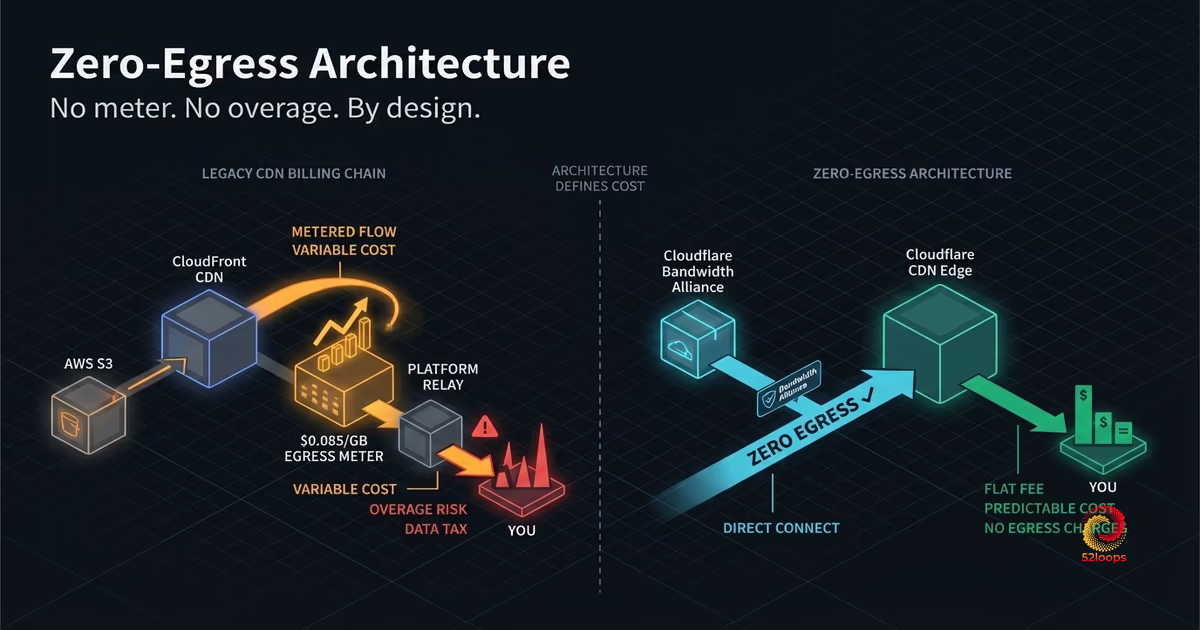
Zero-egress architecture eliminates bandwidth overage bills by routing video delivery through a CDN network where data transfer between nodes costs nothing. Instead of paying per gigabyte of outbound traffic, the cost is absorbed at the infrastructure layer, allowing video hosts to offer fixed-price plans without passing egress fees to customers.
If you have ever opened a hosting invoice the morning after a product launch and felt your stomach drop, you already understand the problem. The numbers were not wrong. The platform delivered exactly what you paid for, at exactly the price you agreed to, then charged you for everything beyond that. That is not a billing error. It is the expected output of an architecture built around variable egress costs. For a practical look at how this architecture creates affordable video hosting for solopreneurs, it helps to see how fixed costs change the math of a small business.
Egress is not a video problem. It is an architecture problem. Architecture problems have architectural solutions.
Why platforms charge overage in the first place
To understand how to eliminate egress fees, you need to understand why they exist.
Legacy video hosting platforms are built on general-purpose cloud infrastructure: Amazon CloudFront, Google Cloud CDN, or similar services. These CDNs charge their customers (the platforms) for every gigabyte of data pushed out to end users. AWS CloudFront prices outbound transfer at roughly $0.085 per GB for the first 10 TB per month in US and European regions.
Platforms do not absorb this cost. They pass it through to you, typically with a margin added.
Follow the money: your student watches a video, bytes leave the CDN, the CDN bills the platform, the platform bills you. Every view is a metered transaction. When your traffic spikes, the bill spikes with it. The platform has no incentive to break this chain. The overage model is profitable for them.
The success tax on video delivery is exactly this: a structural penalty that activates precisely when your product is working. Growth triggers cost instead of efficiency. The full picture of how this plays out is described in why the success tax exists on video delivery.
What egress actually costs at scale
Per-gigabyte billing is abstract until you run it against a real launch.
A one-hour 1080p video stream consumes approximately 2 GB of data per viewer. That is a conservative estimate for adaptive bitrate delivery at a reasonable quality level.
Run that against a modest launch: 5,000 monthly views of your flagship course.
- Data transferred: 5,000 views x 2 GB = 10 TB per month
- AWS CloudFront cost at $0.085/GB: approximately $850 per month, egress alone
That figure does not include storage, encoding, player licensing, or the platform’s margin. It is purely the cost of moving bits from a data center to a browser. For a platform that prices CloudFront egress through to you, $850/month is the floor, not the ceiling.
Bunny.net, a CDN priced more aggressively for media workloads, runs $0.01 to $0.05 per GB depending on region. Even at the low end, 10 TB costs $100/month in egress alone, and more in Asia-Pacific, Latin America, or Africa, where CDN pricing is structurally higher.
Understanding how video hosting overages are calculated does not make them less painful. It tells you exactly which knob is turning the dial up.
Scale to 50,000 views per month and you are looking at 100 TB of egress. At CloudFront rates, that is a number that would concern a CFO at a mid-size company, let alone a solo founder or a small team running a course platform.
The architecture that eliminates egress
Zero-egress architecture removes the per-unit cost at the infrastructure layer before it ever reaches you.
This is not a pricing trick or a marketing reframe. It is a consequence of where data moves and what agreements govern that movement.
Cloudflare operates one of the largest interconnected networks in the world, with points of presence in over 330 cities. Within that network, traffic between Cloudflare services (storage to CDN, for example) carries no egress charge. Cloudflare R2, the object storage layer, does not charge for data transferred out to Cloudflare’s CDN. That is not a promotional rate. It is the baseline.
The Cloudflare Bandwidth Alliance locks this in: zero-cost peering agreements between Cloudflare and partner infrastructure providers mean data moving between them does not incur per-gigabyte transfer fees. The cost is absorbed at the network layer through peering, not metered and passed down the billing chain.
When video is stored in Cloudflare R2 and delivered through Cloudflare’s edge network, the egress cost at the infrastructure layer is zero. Not discounted. Zero.
A platform built on this architecture can offer fixed-price plans because the variable that drives overage billing on other platforms (outbound data transfer) has been removed from the cost model entirely.
The mobile data plan comparison
On a pay-per-use mobile plan, every megabyte costs something. A bad month of travel, a data-heavy app, an unexpected sync, and your invoice reflects it immediately.
On a bulk capacity plan, the carrier has pre-negotiated the infrastructure cost at scale. You pay a fixed monthly amount. There is no per-megabyte invoice because the cost structure on their end is fundamentally different.
Zero-egress video hosting works the same way. The infrastructure layer has absorbed the variable cost through network architecture and peering agreements. What you see is a fixed plan, not a metered bill.
That is what the growth buffer is built on: the ability to absorb traffic increases without turning them into billing surprises.
Why this is an architecture problem, not a pricing problem
A platform that offers “no overage fees” through generous caps or soft limits is not zero-egress architecture. It is deferred billing. The egress cost still exists at their infrastructure layer. They have chosen how to absorb or amortize it for now.
True zero-egress architecture means the cost at the infrastructure layer is structurally eliminated. Cloudflare’s R2-to-CDN model achieves this because peering between Cloudflare services does not generate billable egress events. There is no cost to absorb, defer, or amortize. The variable does not exist.
This distinction has real consequences. Platforms built on legacy CDN infrastructure carry egress costs as a permanent operational liability. When their margins compress, or when they need to grow revenue, the easiest lever is passing more of that cost to you: through overage pricing, usage tiers, or plan restructuring.
A platform built on zero-egress infrastructure does not have that lever. The architecture has removed the liability.
The hidden fees that appear in hosting contracts are a symptom of that legacy architecture. The only reliable way to avoid them is to use infrastructure that does not incur them.
What this means for your hosting decision
If you are evaluating video hosting platforms, the right question is not “what is the overage rate?” The right question is “what is the egress architecture?”
A platform that answers with a CDN provider name (CloudFront, Fastly, Akamai) is telling you that egress costs exist at their infrastructure layer and will eventually reach your bill, directly or indirectly.
A platform that answers with Cloudflare R2 and zero-egress peering is describing a fundamentally different cost structure.
Ask before you commit. The answer tells you more about long-term cost predictability than any pricing page will.
Stop losing money to bandwidth overages
Every month on metered egress is money you cannot recover. Run your actual numbers now and see what zero-egress infrastructure saves you.
Calculate your savingsCalculate what egress is costing you today
Before choosing a platform, run your actual numbers through a capacity calculation. The difference between per-gigabyte egress billing and fixed-capacity pricing is not always obvious from a pricing page. It becomes obvious when you apply it to your real traffic volume.
Use the 52loops Capacity Calculator to enter your monthly view count, average video length, and typical resolution. The output shows your projected egress volume and what that would cost on metered infrastructure versus a fixed-capacity model.
Calculate your egress costs with the 52loops Capacity Calculator
The compounding cost of getting this wrong
Egress fees do not just cost money. They cost predictability.
When your video hosting bill is variable, budget planning becomes approximate. You can estimate, but you cannot commit. For a SaaS product or a course platform with monthly revenue targets, an uncontrolled cost variable in your infrastructure stack creates downstream uncertainty across the whole operation.
Invoice anxiety is that downstream effect: the inability to plan because a core infrastructure cost refuses to settle. It shows up not just in finance spreadsheets but in operational decisions. Teams hold back on marketing spend. Founders delay hiring. Product timelines shift because nobody can confidently forecast what infrastructure will cost next quarter.The less visible cost is opportunity drag. A team spending mental energy on infrastructure bill management is not spending that energy on product. Every hour a founder spends modeling egress scenarios is an hour not spent on customer conversations or feature work.
Raw CDN versus complete video infrastructure makes this contrast clear: assembling your own CDN setup gives you flexibility, but not cost predictability, unless you have the scale and negotiating power to secure zero-egress peering agreements on your own. Most teams do not.
For teams comparing platform options, developer API versus fixed-cost infrastructure covers the same tension from a different angle: the question is not just what you can build, but what operational liability you take on when you build it.
The architecture decision you make today locks in your cost structure for the operational life of your product. A platform running on per-gigabyte egress will always have that variable in its cost model, regardless of what the pricing page says today.
A fixed cost is an operational decision
Video hosting should not be a source of budget anxiety. It should be a settled line item.
Zero-egress architecture makes that possible by removing the variable at the source. Not by capping it, deferring it, or absorbing it through margin compression, but by building on infrastructure where the variable does not exist.
When a course launch brings 10,000 students to a one-hour video on day one, approximately 20 TB of data moves. On CloudFront-backed infrastructure, that is a surprise bill of roughly $1,700 in egress alone. On zero-egress infrastructure, it is Tuesday.
The difference is not pricing strategy. It is architecture.
Choosing a platform without understanding its egress architecture is how teams end up paying for a problem they did not know they had signed up for. Run your numbers before you commit. The architecture that eliminates bandwidth overages exists. The question is whether your current platform is built on it, and if not, how much that gap has already cost you.
Calculate your egress costs with the 52loops Capacity Calculator
Frequently Asked Questions
Most platforms treat your storage and video slots as a "metered" resource that can be taken away or shared. At 52loops, your Highway Units represent reserved capacity.
Think of it like a mobile data plan with a dedicated data bucket: you've bought a specific amount of space and bandwidth that is yours to use. Those slots and gigabytes are dedicated to your account, ensuring guaranteed performance and availability for your assets at all times.
It's the penalty legacy platforms charge you for doing exactly what you set out to do—succeed.
When your video goes viral or your message reaches a massive audience, traditional hosts see that traffic as a "liability" or a cost to be recovered. They trigger automated overage fees or force you onto enterprise plans mid-month, effectively taxing your growth. At 52loops, we view that same traffic as a signal to be amplified, not a billable event.
Invoice Anxiety is the psychological burden felt by business owners when using usage-based billing models. It occurs when success—like a viral video or a successful product launch—leads to unpredictable and often massive overage charges.
Instead of celebrating a win, you're stuck doing damage control on your bank account. We built 52loops specifically to eliminate this anxiety by using Reserved Capacity instead of metered billing.
Egress is simply the movement of data from a server to your viewer. Most platforms use outdated architectures that incur high costs from their own providers, and they pass that markup (often 500% or more) on to you.
By building on a modern, zero-egress backbone and partnering with providers in the Cloudflare Bandwidth Alliance, we eliminate the middleman markup. You pay for the actual delivery, not the legacy company's overhead.