
Every startup accelerator tells you the same thing: grow fast or die. Get as many users as possible. Raise your Series A before you run out of runway. Capture market share at any cost.
If your goal is a billion-dollar exit, this advice is correct. If your goal is a sustainable business that serves real customers well, year after year, without burning out your team or your margins, it falls apart.
I built 52loops differently. I am not aiming for a billion-dollar valuation. I am aiming for 100 happy customers.
That is not false modesty. It is a deliberate infrastructure and business decision that shapes every technical and pricing choice I make. The math behind it is simple, and understanding it changes how you evaluate any video hosting provider.
The Question No One Asks
Here is a question that rarely gets asked in boardrooms but should: what does each new customer actually cost you?
Not just the obvious costs like support tickets and server load, but the hidden ones. The onboarding friction. The feature requests that pull your engineering team in five directions. The edge cases you have to support because your user base now includes a wider range of technical setups. The compliance overhead of serving customers in more jurisdictions. The storage and bandwidth your platform must reserve to handle peak load across a larger, more diverse user base.
SaaS benchmarks consistently show companies with small, focused customer bases running higher net dollar retention than companies with large, heterogeneous ones. Growth does not always improve unit economics. It often worsens them, because every additional customer segment brings complexity your operations were not designed to handle.
The conventional wisdom says you should optimize for growth and fix the operational problems later. “We will figure out support when we have more revenue.” “We will deal with infrastructure scaling when we hit the next milestone.”
This is a bet. Sometimes it pays off. Often it does not. According to CBInsights research, 14% of startups fail because they run out of cash while trying to grow too fast, and 17% fail because they get outpaced by competitors they were trying to outgrow (source). Growth itself is not a strategy. Sustainable unit economics is.
The Hidden Cost of Every Customer
When you add a customer to an infrastructure platform, you are not just adding a revenue stream. You are adding a commitment. That customer’s videos need to be available when they are requested. Their storage needs to be durable. Their bandwidth allocation needs to exist before the traffic arrives, because in video, provisioning after the fact means buffering.
This is where the reserved-capacity model diverges from the pooled model most platforms use. We have explained this difference before using the mobile data plan analogy, and the core insight is worth restating here.
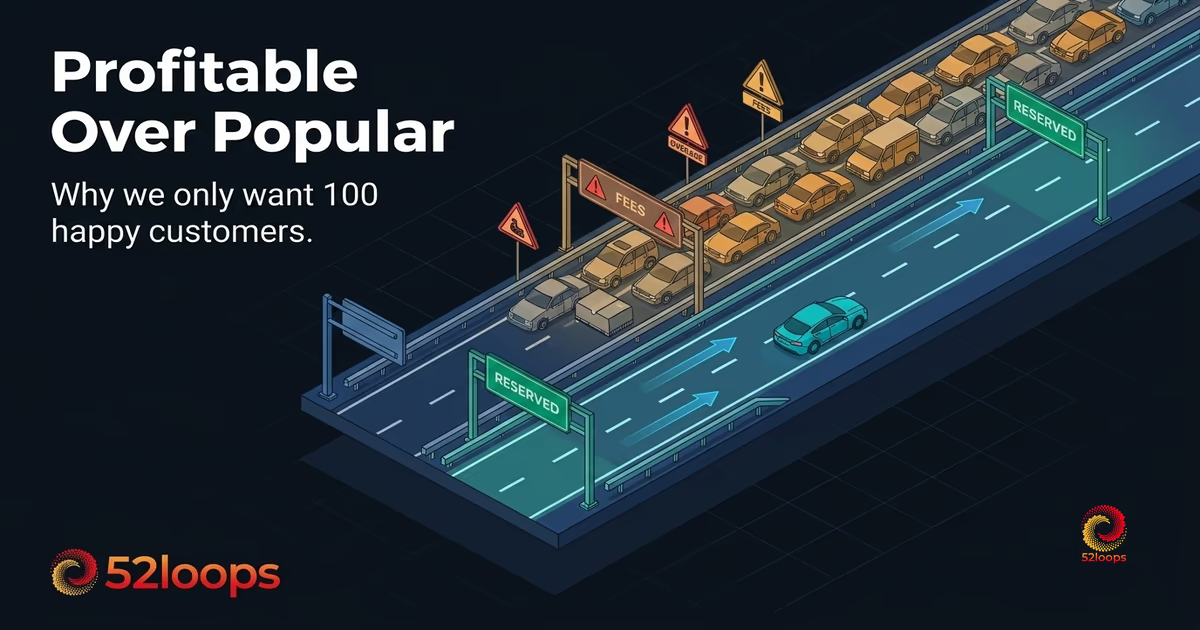
In a pooled model, adding a customer is cheap at the margin. You throw them into the shared bucket, similar to how most video hosting platforms structure their backend. The statistical distribution means most customers will not use their full allocation most of the time, so your aggregate provisioning can be less than the sum of individual limits. This is the airline overbooking approach to infrastructure, and it works until it does not. When too many customers have a busy day simultaneously, everyone’s performance degrades.
In a reserved-capacity model like ours, each customer gets a dedicated slice. A Highway Unit is pre-allocated. The bandwidth exists before the customer uses it. The storage is provisioned. There is no statistical smoothing. There is no overbooking.
This means each customer has a real, measurable infrastructure cost that does not decrease as we add more customers. Adding customer number 101 costs roughly the same as adding customer number 1. There are no volume discounts in physics.
That is a feature, not a bug. Your experience does not degrade when the platform grows because there is no pool to congest. And since our economics are linear, we have no incentive to chase millions of customers. Linear economics favor quality over quantity every time.
According to Paddle’s SaaS research, expansion revenue from existing customers is 4x cheaper to generate than new customer acquisition (source). The companies that capture that expansion revenue do not treat customers as interchangeable units. They treat them as relationships worth maintaining. You cannot maintain deep relationships with 10,000 customers when you have a team of three. You can maintain them with 100.
What 100 Customers Buys You
Let me walk through the math, because the numbers change how you think about what is possible.
At $20 per month per Highway Unit, 100 customers generate $2,000 in monthly recurring revenue, or $24,000 annually. This is a conservative baseline. Most customers will need more than one unit as their usage grows, so the actual average revenue per account is higher.
For a lean infrastructure business with a small team, efficient cloud architecture, and no sales team to feed, $2,000 a month supports sustainable operations. It keeps the infrastructure running, pays the people maintaining it, and leaves room to invest in improvements without needing outside capital.
What matters more is what 100 customers makes possible.
Every customer can reach me personally. Not through a chatbot or a ticket system routed to level 1 support, but to the person who built the platform. That is not scalable at 10,000 customers. It is entirely feasible at 100.
Feature requests come with context. I know who is asking, what they are building, and why it matters. I can evaluate each request against the actual needs of an actual user, not against a statistical projection of what “the market” wants.
According to Recurly Research, the median monthly churn rate for SaaS companies sits between 3% and 5% (source). For companies with fewer than 100 customers and direct founder involvement, that rate drops dramatically. When a customer has a problem, they tell you directly instead of silently canceling their subscription.
And when you have 100 profitable customers and no outside investors, there is no one telling you to grow faster. You make decisions based on what is right for the product and the people using it, not on quarterly growth targets.
This model is not for everyone. Some businesses need millions of users to function (social networks, marketplaces, ad-supported platforms). But for infrastructure, where the value is reliability and predictability, 100 deep relationships beat 10,000 shallow ones every time. The case for choosing that path deliberately is laid out in the boring business manifesto.
The Infrastructure Implication
The decision to target 100 customers is not a marketing gimmick. It has real architectural consequences that benefit every customer, much like the zero-egress architecture we built to eliminate overage risk.
Capacity planning becomes honest. When you know your maximum customer count within an order of magnitude, you can provision infrastructure accordingly. You are not guessing whether next month will bring 10 new customers or 10,000. You are planning for steady, predictable growth that your infrastructure can absorb without compromising quality.
Noisy neighbors disappear. In pooled infrastructure, the biggest threat to your video quality is not your own traffic; it is someone else’s. When another account on the same shared edge has a viral moment, your available bandwidth compresses. With reserved capacity and a small, curated customer base, that scenario does not happen. Your throughput is your throughput regardless of what anyone else is doing.
Support quality is not a statistical game. Most platforms optimize support for scale. They build knowledge bases, deploy chatbots, and measure resolution time as a metric to be minimized. The goal is to get the ticket closed, not to get the customer unblocked. When your customer count is 100, support is not a cost center to be optimized away. It is the core feedback loop that drives product decisions.
A 2024 study on consumer billing experiences found that 54% of customers who encountered an unexpected issue or confusing communication abandoned their purchase or did not sign up for service (source). When customers feel heard and understand what is happening, they stay. Contextual understanding is a function of density: how many customers per support person. At 100 customers per founder, the density is ideal.
The Anti-Success Tax Connection
This is where the philosophy connects directly to the Success Tax .
Legacy platforms charge a Success Tax because they are designed to scale to millions of users. To make that work, they use pooled infrastructure, low entry prices, and overage penalties. The model extracts more from the customers who succeed because the platform is built for volume, not for value. Each individual customer is a statistic, and the business model optimizes for aggregate metrics, not individual outcomes.
When your goal is 100 happy customers, you do not need a Success Tax. You do not need free tiers that attract millions of users who will never pay. You do not need overage billing to extract more from the ones who do. You do not need “Fair Use” clauses that let you penalize success when it happens.
You need a simple, transparent pricing model. You need a Growth Buffer that absorbs traffic spikes without penalizing the customer. You need reserved capacity that guarantees performance regardless of what anyone else on the platform is doing.
The anti-success-tax is not just a pricing model. It is a customer count philosophy. You cannot have 100 customers and a Success Tax. The numbers do not work. If you only have 100 customers, every single one of them matters, and penalizing them for succeeding would be self-destructive.
This alignment is structural. The business model and the customer philosophy reinforce each other. Fewer customers means better service, which means lower churn, which means stable revenue, which means no pressure to extract more from the customers you have. The Success Tax disappears because the incentives that create it no longer exist.
What We Give Up
I want to be honest about what we give up.
No community forums buzzing with activity. No third-party integrations ecosystem driven by developer demand. No case studies from every industry vertical. The network effects that come with a large user base are real, and we do not get them.
No VC valuation multiples either. This business will never be worth 50x revenue because it is not growing at 100% year over year. It will be worth a more modest multiple. I am fine with that.
If one customer leaves, that is 1% of our revenue gone, not 0.01%. Every departure is felt. That also means every departure teaches us something we would have missed if we had a thousand names in the churn column.
And the easy narrative is not available to us. “Profitable over popular” sounds right in a tweet, but it is harder to explain to someone used to platforms boasting about millions of users. It requires a longer conversation about what actually matters in infrastructure.
These trade-offs are real. I have weighed each one and concluded the benefits outweigh the costs for the type of business I am building.
Why We Built It This Way
I built 52loops because I was tired of platforms that treated my success as a liability. I wanted infrastructure that aligned its incentives with mine. A provider that would celebrate growth instead of invoicing for it.
That alignment is easier to achieve when you are not trying to please investors, acquire millions of users, or build a billion-dollar company. It is easier when your goal is simply to serve 100 customers so well they never want to leave.
The 100-customer philosophy is not a cap. It is a signal. It tells potential customers what I value: depth over breadth, quality over quantity, sustainability over speed. It tells our small team what to optimize for: retention over acquisition, relationship over transaction.
If we end up with 150 customers because the product keeps attracting people who need it, that is a good problem. But this is not a growth machine designed to hit 10,000. It is an infrastructure platform designed to serve a small number of customers exceptionally well.
This is what profitable over popular looks like in practice. It is a design constraint that produces better outcomes for every customer we have.
The pricing reflects this: one Highway Unit at one flat rate. No overages. No Success Tax. No growth penalties. For more on how this works in practice, the growth buffer explains how we handle traffic spikes, and the no-free-tier philosophy explains why we do not offer a free plan.
Frequently Asked Questions
Most platforms treat your storage and video slots as a "metered" resource that can be taken away or shared. At 52loops, your Highway Units represent reserved capacity.
Think of it like a mobile data plan with a dedicated data bucket: you've bought a specific amount of space and bandwidth that is yours to use. Those slots and gigabytes are dedicated to your account, ensuring guaranteed performance and availability for your assets at all times.
It's the penalty legacy platforms charge you for doing exactly what you set out to do—succeed.
When your video goes viral or your message reaches a massive audience, traditional hosts see that traffic as a "liability" or a cost to be recovered. They trigger automated overage fees or force you onto enterprise plans mid-month, effectively taxing your growth. At 52loops, we view that same traffic as a signal to be amplified, not a billable event.
The "Success Tax " is one of the things I hate most about legacy platforms. If a video goes viral, you shouldn't get a terrifying bill.
At 52loops, if you genuinely cross your unit limits mid-month, the system automatically adds an additional "Highway Unit " to your account to keep things stable. I cover the cost of that upgrade for the rest of your current billing cycle.
Example: Imagine you have 1 Highway Unit (1TB Bandwidth). On the 15th of the month, a video goes viral and you hit 2.5TB. 1. We automatically add a 3rd Unit (increasing your limit to 3TB). 2. Your videos keep playing without interruption. 3. You pay $0 extra for that 3rd unit for the remainder of the month. 4. At the start of the next cycle, you can choose to keep the 3rd unit if your growth is permanent, or drop back to 1 unit if it was just a temporary spike.
Most video hosts offer a free tier to inflate their user numbers, but they often end up hiding the real costs in bandwidth "overages" or "fair use" penalties later on.
It seems to me that when you have 10,000 free users, the paying customers are the ones actually subsidizing the bill. I'd rather keep the circuit exclusive to people who are serious about their work. By requiring a commitment upfront, I can ensure the platform remains fast and the infrastructure stays high-performance for everyone involved.
The 7-day no-hassle refund is a way to try it out and see if it works for you.