
The Question We Get Every Week
No, 52loops does not have a free tier. Not a trial tier, not a freemium plan, not a limited-feature starter option.
The question shows up in the inbox regularly, usually framed as a comparison: “Competitor X gives me 10GB free, why don’t you?” It is a fair question. Free is a powerful word. The zero-price effect is real, documented in behavioral economics research, and it works on almost everyone, including people who know it is working on them. A reduction in price from $1 to zero is more powerful than a reduction from $2 to $1, because something offered for free generates a disproportionate emotional pull that a simple price comparison cannot explain.
But “free” in SaaS infrastructure is never actually free. The cost exists. The question is who absorbs it, and what it does to the platform’s architecture when it does.
This article explains the infrastructure reason behind this decision, not the commercial one. Understanding it changes how you evaluate any video hosting platform, including this one.
What a Free Tier Actually Requires
A free tier is not a pricing strategy. It is an infrastructure architecture decision that cascades through every part of how a platform provisions, allocates, and manages capacity.
Shared Infrastructure Is Not Optional
When a platform offers a free tier, it cannot provision dedicated resources for every free user. The math does not work. CDN egress is a commodity cost with a real floor. Delivering a 1080p stream requires roughly 3 to 8 Mbps of sustained throughput per viewer, as specified in Apple’s HLS authoring specification and documented in the IETF HLS standard (RFC 8216). That bandwidth costs something per gigabyte regardless of what the user pays. Storage has a floor. Compute has a floor.
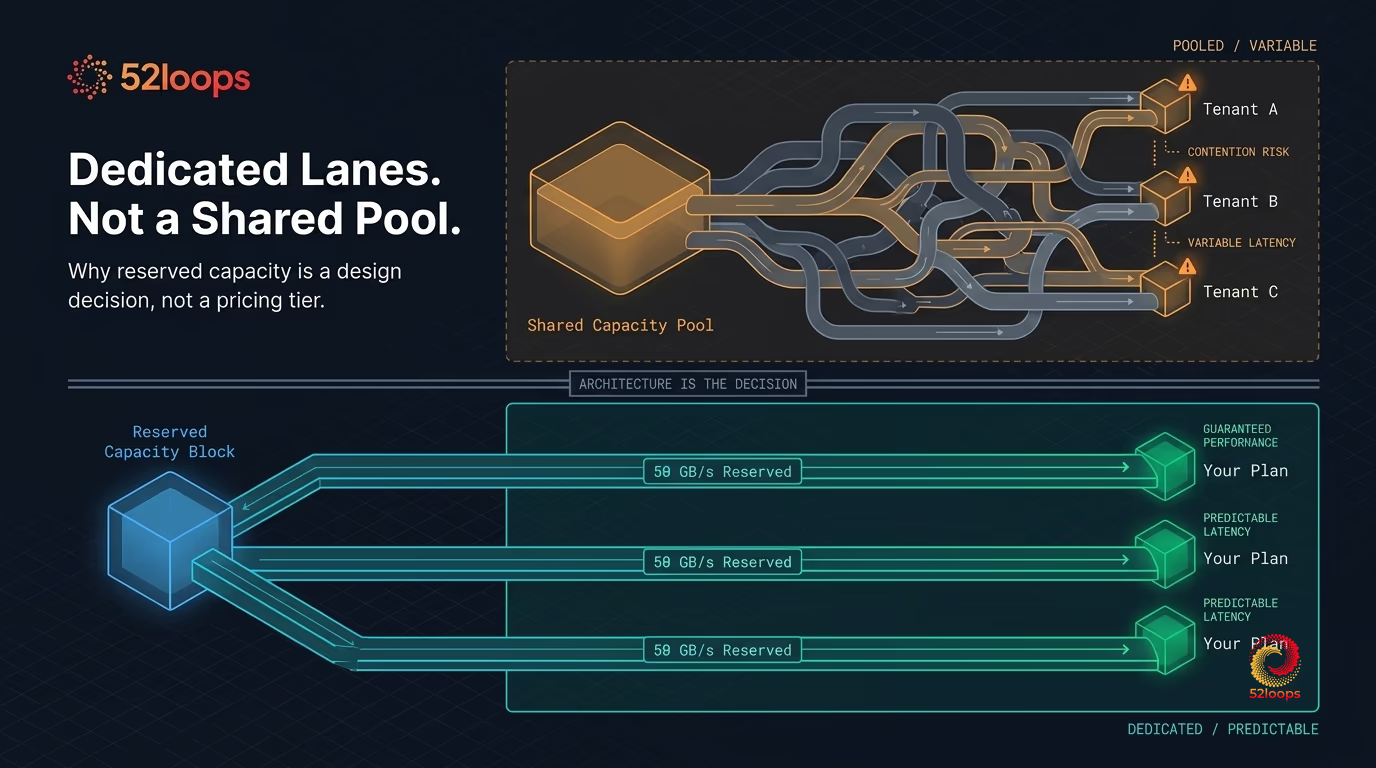
To absorb those costs across thousands or millions of non-paying users, platforms pool their infrastructure. Free users share bandwidth capacity, storage buckets, and egress pathways with each other and, critically, with paying customers on lower-tier plans. The pool is the only economically viable design. There is no alternative architecture for a sustainable free tier at scale.
This is not a criticism of that model. It is a description of it. Pooled infrastructure is a legitimate engineering choice, just a different one than reserved capacity, and those two choices are not compatible with each other.
Paying Customers Subsidize Free Users
According to Paddle’s freemium research and OpenView Partners’ SaaS pricing guide, freemium products in SaaS convert between 2% and 5% of free users to paid. OpenView’s data from 458 SaaS companies puts the freemium-to-paid rate at roughly 5%, which yields a net visitor-to-customer rate closer to 0.3%. For every 100 free users, somewhere between 95 and 98 will never pay. Their bandwidth consumption, their storage usage, and their CDN delivery costs are real. Those costs go somewhere.
They go to the paying customers.
Not directly, not as a line item, but through the pricing math that makes the business model viable. The platform prices its paid plans to cover not just the infrastructure those paying customers consume, but the infrastructure the non-paying users consume as well. This is the subsidy problem, and it mirrors the Success Tax dynamic in reverse: instead of penalizing growth, the free tier redistributes cost from non-paying users to paying ones.
This dynamic is not theoretical. Heroku eliminated its free tier in 2022, citing the “extraordinary amount of effort” its engineering and security teams spent managing abuse of free plans. PlanetScale dropped its free database tier in 2024 for the same structural reason: free tiers impose real infrastructure costs that the business model cannot sustainably absorb. The hidden costs in free and usage-based models compound as a platform grows. The free tier entry point is often the acquisition mechanism for a billing structure that extracts more later, from the paying customers subsidizing it.
The Reserved-Capacity Model Cannot Coexist With a Free Tier
This is the core of the decision. 52loops is built on a reserved-capacity model. That model is structurally incompatible with offering a free tier, not commercially inconvenient, structurally incompatible.
What a Highway Unit Is
A Highway Unit is the fundamental unit of capacity at 52loops. One unit is a fixed bucket: 1TB of bandwidth and 100GB of storage. Every feature, the player, global CDN delivery, ad-free hosting, and referer protection, is included in every unit. There are no add-ons. There are no overages.
The framing comes from the mobile data plan analogy: a Highway Unit works like a dedicated data plan. It is yours, allocated to your account, guaranteed to be available when you need it. You are not competing with other accounts for bandwidth during a traffic spike. You are not sharing a pool that degrades when the platform has a busy hour.
This is what reserved capacity means in practice. It is not a marketing term. It is a provisioning decision made at the infrastructure level before any customer signs up.
Dedicated Slices vs. Pooled Buckets
The zero-egress architecture that underpins 52loops depends on capacity being reserved, not shared. Dedicated slices of bandwidth and storage are pre-allocated per account. The capacity exists before the customer uses it.
Pooled buckets work the opposite way. Capacity is shared across all users, and the platform manages allocation dynamically. This is efficient from a utilization standpoint, operating on the same principle as airline overbooking: statistically, not everyone uses their full allocation at the same time, so the pool can be smaller than the sum of all allocations.
That statistical efficiency is what makes free tiers viable, and it is exactly what reserved capacity eliminates.
If 52loops offered a free tier, it would need to provision shared, pooled infrastructure for those users. That pool would exist on the same network as paying customers. Under any load spike driven by free users, paying customers’ performance would degrade. The physics of the network do not have an exception clause for billing tier.
The two models cannot share the same infrastructure. Offering a free tier would mean building a separate pooled stack for free users, which doubles operational complexity and cost, or it would mean compromising the reserved-capacity model for everyone. Neither is acceptable.
What This Means for Your Player Performance
The absence of a free tier has a direct, measurable effect on the playback experience every paying customer gets. This is not an accounting decision; it is an architecture one.
No Noisy Neighbors
“Noisy neighbor” is the infrastructure term for what happens when one tenant on shared infrastructure consumes disproportionate resources and degrades performance for adjacent tenants. AWS’s Well-Architected Framework describes it directly: “workloads in a multi-tenant environment can be unpredictable,” and SaaS architectures must “manage and minimize the potential impacts of noisy tenants.” It is endemic to any platform that pools capacity.
On 52loops, there are no free users consuming shared bandwidth during your peak traffic window. There is no scenario where a viral moment for another account on the same infrastructure compresses your available throughput. Your Highway Unit is yours. What happens on other accounts does not affect what you have allocated.
This matters most for course creators hosting high-value video content. A 1080p stream at 6 Mbps average bitrate needs consistent, uninterrupted throughput. A degraded CDN edge under load produces buffering, and buffering during a course lesson is not a minor inconvenience, it is a trust problem with students.
Predictable Throughput Under Load
Reserved capacity means your throughput floor is the same whether you are serving one viewer or a thousand. The Highway Unit pre-allocates the bandwidth. The CDN delivers from that allocation. The player on the other end sees consistent latency and bitrate because the capacity backing it does not fluctuate with platform-wide demand.
This is the same principle an Infrastructure Anchor delivers on the billing side: stability is a design goal, not a side effect. Predictable cost and predictable performance come from the same architectural decision. That choice to build for certainty rather than speed is what the boring business manifesto is about.
How We Handle Evaluation Without a Free Tier
The legitimate purpose of a free tier is evaluation. A prospective customer wants to know whether the platform works before committing to a billing relationship. That is reasonable. A free tier is one mechanism for enabling that, but it is not the only one.
52loops offers a 7-day money-back guarantee. Sign up, connect your player, test your content under real conditions on real infrastructure with dedicated capacity, and if it is not the right fit within seven days, you get a full refund. No questions asked.
This accomplishes the evaluation goal without the infrastructure compromise. The customer tests on the actual reserved-capacity stack they would use as a paying customer, not on a shared free-tier pool that behaves differently under load. The evaluation is accurate precisely because it uses the same infrastructure.
A free tier would give a prospective customer a degraded, pooled experience and call it a trial. That is not useful information. The 7-day money-back guarantee gives them the real product, on the same infrastructure they would use every day as a paying customer.
The Honest Trade-Off
No free tier means a higher barrier to entry. That is a real cost. Some customers who would have tried the platform on a free tier will not convert because the commitment threshold is higher. That is a deliberate trade-off, not an oversight. The broader philosophy behind this, choosing 100 deeply-served customers over 10,000 shallow ones, is explained in Profitable Over Popular: Why We Only Want 100 Happy Customers.
The alternative, offering a free tier, would require either pooling infrastructure or building a separate free-tier stack. Pooled infrastructure degrades the reserved-capacity model for paying customers. A separate stack adds operational complexity that eventually surfaces as higher costs or slower development velocity. Both options compromise the platform in ways that matter to the customers it is designed to serve.
The upgrade path at 52loops is designed to scale predictably. A Growth Buffer means you are not punished for traffic spikes or storage growth. Adding another Highway Unit when you need more capacity is a straightforward decision with a predictable cost. There is no moment where your bill doubles because you had a good month.
The pricing is on the pricing page: one Highway Unit, one flat rate, no overages.
This is the honest version of the trade-off: a higher entry barrier in exchange for an architecture that does not penalize you for succeeding, does not degrade under shared load, and does not hide costs in the gap between what “free” promises and what the invoice eventually says.
The infrastructure reason is simple. Reserved capacity cannot coexist with shared, pooled free-tier infrastructure. One of them has to give. We chose to keep the reserved capacity.
Frequently Asked Questions
A Highway Unit is the fundamental building block of your 52loops account. Instead of forcing you into restrictive tiers, we provide you with a fixed bucket of resources.
Every single feature, including our high-performance Player, Global CDN, ad-free hosting, and referer protection—is included in every Highway Unit.
Each unit provides a base of: - 1TB Bandwidth (Upgraded to 2TB for Founding members ) - 100GB Storage - 100 Video Slots
As your business grows, you simply add more units to increase these limits. See How Stacking Units works .
Most platforms treat your storage and video slots as a "metered" resource that can be taken away or shared. At 52loops, your Highway Units represent reserved capacity.
Think of it like a mobile data plan with a dedicated data bucket: you've bought a specific amount of space and bandwidth that is yours to use. Those slots and gigabytes are dedicated to your account, ensuring guaranteed performance and availability for your assets at all times.
An Infrastructure Anchor is a philosophy of billing that prioritizes stability and predictability over variable "metered" costs.
In the same way an anchor holds a ship steady during a storm, your Infrastructure Anchor ensures your hosting expenses remain fixed and manageable even during traffic spikes. By using Highway Units , we provide a stable backbone for your business operations so you can focus on growth without fear of your tools turning against you.
Yes. I want you to be completely confident in the circuit you're building. We offer a 7-day no-hassle refund guarantee. If you find that 52loops doesn't fit your workflow within the first week, just send me an email and I'll refund your payment in full, no questions asked.
Most video hosts offer a free tier to inflate their user numbers, but they often end up hiding the real costs in bandwidth "overages" or "fair use" penalties later on.
It seems to me that when you have 10,000 free users, the paying customers are the ones actually subsidizing the bill. I'd rather keep the circuit exclusive to people who are serious about their work. By requiring a commitment upfront, I can ensure the platform remains fast and the infrastructure stays high-performance for everyone involved.
The 7-day no-hassle refund is a way to try it out and see if it works for you.