
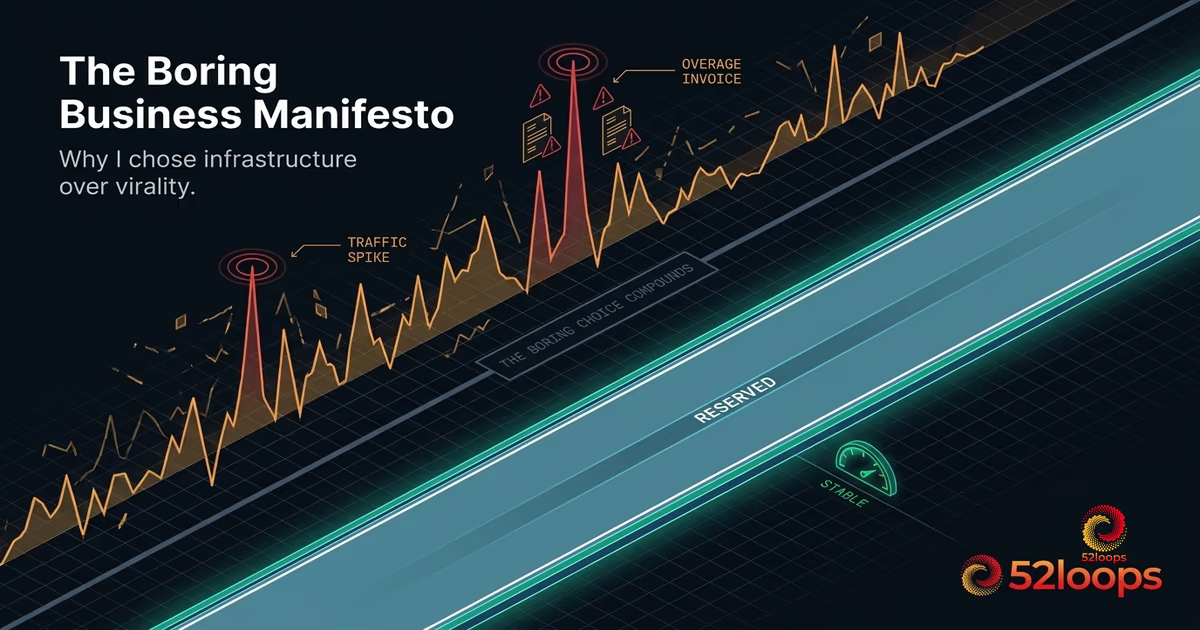
Everyone optimizes for virality. I optimized for not being surprised by my own bill.
The startup world has a default script: grow fast, acquire users at a loss, figure out monetization later, chase the hockey stick, raise the next round before you need it. That script has produced some remarkable companies. It has also produced a graveyard of well-funded platforms that ran out of road before they figured out unit economics.
I did not write a different script because I am smarter than those who followed the default one. I wrote it because I saw what it looked like from inside the infrastructure, and I did not like what I saw.
The Seduction of Viral
Viral growth feels like a problem solved. When a video blows up or a product launch floods your sign-up page, the natural response is relief. The acquisition machine works. The growth metrics look good. Investors are happy.
What you do not see immediately is the infrastructure trap underneath.
Most video hosting platforms run on pooled, usage-based models. That model is cheap to provision at scale because it relies on statistical distribution: most customers will not use their full allocation simultaneously, so the platform does not need to reserve capacity for everyone at once. It works fine when growth is linear and predictable. It becomes a liability the moment virality hits.
When your video breaks through and traffic spikes, the platform’s pooled capacity gets tested. If the pool cannot absorb the spike, buffering follows. On usage-based billing platforms, that spike also triggers automated overage fees. You do not find out until the bill arrives. You were celebrating a successful launch. The platform was generating an invoice.
According to Zuora’s Subscription Economy Index, businesses on usage-based billing see 23% higher involuntary churn compared to fixed-subscription models, because customers who cannot predict their bill are less likely to stay (source). The invoice is not just a bad experience. It is a churn event.
The seduction of viral is real. The platforms that benefit most from your traffic spike are the same ones billing you for it.
The Bill That Changed My Thinking
There was one bill that settled it for me.
I have written about the $640 bill before. It arrived after a good month, not a bad one. A video performed well. Traffic went up. The bill arrived, and the number on it was not proportional to anything I had agreed to. It was a penalty for doing what the platform was supposed to help me do.
That moment named something I had felt for a while without being able to articulate it: invoice anxiety is not a pricing problem. It is a design problem. The anxiety is not caused by the amount of the bill. It is caused by unpredictability. You cannot run a calm business when one line item on your balance sheet is a variable you cannot control.
This is the core of the Success Tax . Legacy platforms charge more when you succeed because their architecture requires it. The pricing model is not arbitrary. It reflects the underlying infrastructure decision to pool capacity and meter usage. When you grow, you use more of the pool, so they charge more. The penalty is structural.
I decided to build the opposite. Not because the economics were obviously better at the time, but because I could not build something I did not believe in.
Boring Infrastructure Compounds Quietly
Boring infrastructure is not a consolation prize. It is an asset class.
Think about the difference between a casino and a mortgage. A casino creates the impression of growth through volatility. Some bets pay off spectacularly. Most do not. The expected value tilts toward the house. The casino is designed to capture value from the player’s hope.
A mortgage is the opposite. Slow, predictable, compounding. Month after month, the payment stays the same. The interest decreases. Equity builds. There is no excitement. There is also no surprise invoice.
fixed, reserved capacity infrastructure works like the mortgage. When you buy a Highway Unit , you are not renting access to a shared pool. You are reserving a dedicated slice: 1 TB of bandwidth, 100 GB of storage. That capacity exists before your traffic arrives. It is pre-provisioned, not metered.The compound effect is operational. Customers who never worry about their bill stay. The business stabilizes. Instead of burning budget replacing churn, I invest in infrastructure improvements.
According to Harvard Business Review, increasing customer retention by just 5% can increase profits between 25% and 95% (source). Retention is a function of trust. Trust is a function of predictability. Predictability is an infrastructure decision before it is a customer success strategy.
The Growth Buffer is the mechanical expression of this philosophy. If your traffic spikes mid-month and you exceed your current capacity, we absorb the cost for the rest of that billing cycle. Capacity adjusts automatically. You pay nothing extra until the next cycle, when you can decide whether to keep it. The mechanics of how this works are designed specifically to remove the panic from the moment of success.
A bill that stays the same every month, or adjusts only when you decide to grow, is not exciting. It is also not terrifying. That is the whole point.
Viral Growth Creates the Wrong Customers
Viral growth has a selection problem that rarely shows up in the post-mortem: it attracts the wrong customers.
When a campaign goes viral, it attracts a broad, shallow audience. Some portion has real, sustained need for your product. A larger portion signed up because of the moment, the meme, the recommendation from someone they follow. They are not evaluating your platform against their operational requirements. They are experimenting.
When the experiment ends, they churn. If the bill surprised them during the experiment, they churn loudly.
The customers I want at 52loops are the ones who evaluated their video infrastructure requirements carefully, understood the reserved-capacity model, decided it matched their operational needs, and signed up deliberately. These customers are not here because of a TikTok. They are here because they read the infrastructure philosophy, compared it to their current provider, and made a considered decision.
Those customers almost never churn due to invoice anxiety. They knew what they were paying before they signed up. The bill is not a surprise. It is a confirmation.
The full argument for this is in the “profitable over popular” philosophy. The short version: 100 customers who never check their hosting invoice are worth more than 10,000 daily active users whose churn rate spikes whenever the bill arrives.
The operational math makes this concrete. When customers do not churn, capacity planning is honest. When customers choose deliberately, support conversations are substantive. When customers stay for years, the unit economics hold without needing to replace 40% of your revenue base every twelve months.
Predictability Attracts the Right Builders
The customers who respond to “boring, predictable video infrastructure” are telling you something about themselves. They are operators burned before. SaaS founders who built something real and watched a surprise invoice land mid-month. Course creators who launched a cohort, celebrated a successful run, and then opened a hosting bill that ate the margin.
These customers are not looking for a platform that will help them go viral. They are looking for a platform that will not punish them when they do.
Positioning 52loops as a Infrastructure Anchor is deliberately unsexy. I do not use words like “revolutionary” or “disruptive.” I do not promise to 10x your engagement. I promise that your video bill will be the same next month as it is this month, and that if your business grows faster than expected, we will handle the spike without generating an invoice that makes you regret the success.
That positioning filters out the wrong customers automatically. No one looking for a viral platform with a gamified dashboard and AI-powered content recommendations will sign up for 52loops. Good. That is exactly what the no-free-tier decision enforces. Free tiers attract volume, experimenters, students, and people who will never pay. They also create infrastructure overhead that gets paid for by the customers who do.
By pricing at a level that requires deliberate evaluation, I ensure that the first interaction a customer has with 52loops is a considered one. They are not experimenting. They are choosing.
Customers who choose this way do not compare us to YouTube or TikTok. They compare us to AWS, to Cloudflare, to the infrastructure providers they rely on for the rest of their stack. They evaluate reliability, pricing transparency, and support quality. Those are the metrics I can actually deliver on. They are also the metrics that produce long-term retention.
What I Give Up
The costs of this approach are real, and honesty about trade-offs is part of the philosophy.
Speed goes first. The deliberate acquisition model is slower than viral. I cannot run a launch campaign that brings in 5,000 sign-ups over a weekend and filter for the right ones later. I filter first, which means the top of the funnel is narrower and the conversion process is longer.
Valuation multiples go next. This business will not be worth 50x revenue because it is not growing at 300% year over year. The investors who look for hockey sticks will not be interested. That is fine, because I am not looking for those investors.
The easy narrative goes too. “Built for operators who hate invoice surprises” does not fit on a billboard. It requires explanation. Every potential customer needs to understand the reserved-capacity model before they can evaluate whether it fits their needs. That cognitive load is higher than “free to start, upgrade when you’re ready.”
Network effects from large user numbers do not exist here. There is no community forum buzzing with integrations built by a developer ecosystem. There is no “10,000 creators use 52loops” social proof in the header. Those numbers attract more users of the same type, and I have deliberately chosen a type that does not respond to those numbers anyway.
Each of these trade-offs is real. I took each one seriously before committing to this path. The compounding benefits of the boring model outweigh them, not because the math guarantees it, but because the alternative would require me to build a platform optimized for viral growth and usage-based billing. That is a platform I do not believe in. The growth curve is not worth that.
The Manifesto
These are not values for a pitch deck. They are operational choices that shape every technical and pricing decision I make.
Boring infrastructure compounds. The reliable thing builds equity slowly and invisibly. The exciting thing spikes and crashes. I am building the reliable thing.
Invoice anxiety is a design problem. If your customers dread opening their hosting bill, the architecture is wrong, not the customer. Reserved capacity solves this at the foundation, not at the support level.
Predictability attracts operators. The customers who value a stable, knowable monthly cost are the customers who evaluate carefully, churn rarely, and give useful feedback. These are the customers worth building for.
Viral growth selects for the wrong customers. The audience that shows up because of a moment is not the audience that stays because of the product. 100 customers who chose deliberately are worth more than 10,000 who arrived by accident.
A boring business is not a small ambition. It is a different ambition. Profitable, sustainable, and serving its customers well, year after year, without burning out the team or the margins. That is a harder path than most people choose, because it does not produce a compelling pitch deck. It produces a working business.
If this sounds boring to you, good. That is the point.
Frequently Asked Questions
A Highway Unit is the fundamental building block of your 52loops account. Instead of forcing you into restrictive tiers, we provide you with a fixed bucket of resources.
Every single feature, including our high-performance Player, Global CDN, ad-free hosting, and referer protection—is included in every Highway Unit.
Each unit provides a base of: - 1TB Bandwidth (Upgraded to 2TB for Founding members ) - 100GB Storage - 100 Video Slots
As your business grows, you simply add more units to increase these limits. See How Stacking Units works .
Most platforms treat your storage and video slots as a "metered" resource that can be taken away or shared. At 52loops, your Highway Units represent reserved capacity.
Think of it like a mobile data plan with a dedicated data bucket: you've bought a specific amount of space and bandwidth that is yours to use. Those slots and gigabytes are dedicated to your account, ensuring guaranteed performance and availability for your assets at all times.
It's the penalty legacy platforms charge you for doing exactly what you set out to do—succeed.
When your video goes viral or your message reaches a massive audience, traditional hosts see that traffic as a "liability" or a cost to be recovered. They trigger automated overage fees or force you onto enterprise plans mid-month, effectively taxing your growth. At 52loops, we view that same traffic as a signal to be amplified, not a billable event.
The "Success Tax " is one of the things I hate most about legacy platforms. If a video goes viral, you shouldn't get a terrifying bill.
At 52loops, if you genuinely cross your unit limits mid-month, the system automatically adds an additional "Highway Unit " to your account to keep things stable. I cover the cost of that upgrade for the rest of your current billing cycle.
Example: Imagine you have 1 Highway Unit (1TB Bandwidth). On the 15th of the month, a video goes viral and you hit 2.5TB. 1. We automatically add a 3rd Unit (increasing your limit to 3TB). 2. Your videos keep playing without interruption. 3. You pay $0 extra for that 3rd unit for the remainder of the month. 4. At the start of the next cycle, you can choose to keep the 3rd unit if your growth is permanent, or drop back to 1 unit if it was just a temporary spike.
An Infrastructure Anchor is a philosophy of billing that prioritizes stability and predictability over variable "metered" costs.
In the same way an anchor holds a ship steady during a storm, your Infrastructure Anchor ensures your hosting expenses remain fixed and manageable even during traffic spikes. By using Highway Units , we provide a stable backbone for your business operations so you can focus on growth without fear of your tools turning against you.
Most video hosts offer a free tier to inflate their user numbers, but they often end up hiding the real costs in bandwidth "overages" or "fair use" penalties later on.
It seems to me that when you have 10,000 free users, the paying customers are the ones actually subsidizing the bill. I'd rather keep the circuit exclusive to people who are serious about their work. By requiring a commitment upfront, I can ensure the platform remains fast and the infrastructure stays high-performance for everyone involved.
The 7-day no-hassle refund is a way to try it out and see if it works for you.