
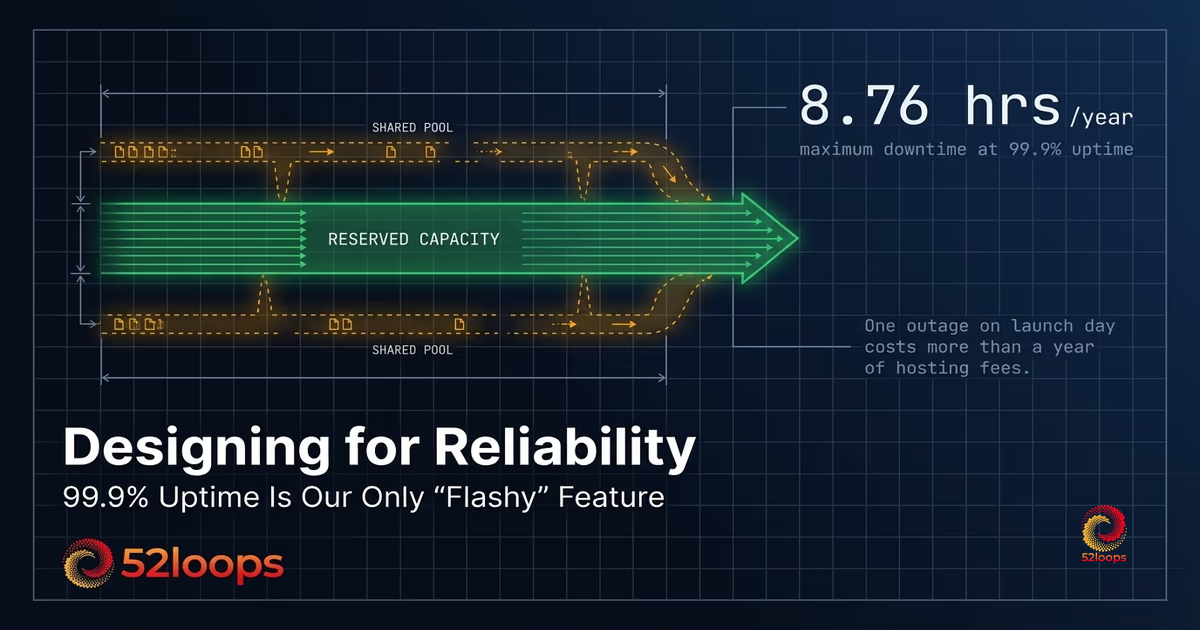
99.9% video hosting uptime sounds like a strong guarantee. Run the arithmetic and it becomes more specific: that figure allows 8.76 hours of downtime per year. Most platforms publish that number and move on. They treat it as a checkbox in a pricing table rather than an engineering commitment.
The question that matters is not whether 8.76 hours is acceptable in aggregate. The question is when those hours fall.
A video platform going down on a quiet Tuesday afternoon is an inconvenience. The platform issues an incident report. Users get frustrated. Life continues. That same platform going down on the morning of your largest course launch is not an inconvenience. It is a financial loss from stalled enrollments, reputational damage in a community that talks loudly, and hours spent managing a crisis instead of welcoming paying students. That gap between “inconvenience” and “catastrophe” is where the real Success Tax lives, and it has nothing to do with your billing.
This article covers what reliable video hosting actually requires, why most platforms do not deliver it, and how architecture determines whether 99.9% uptime is a promise or a hope.
The Math Nobody Explains
Uptime is a percentage of total available time in a given period. The industry standard tiers translate to concrete hours per year as follows:
- 99% allows 87.6 hours of downtime per year (roughly 3.65 days)
- 99.9% allows 8.76 hours of downtime per year
- 99.95% allows 4.38 hours of downtime per year
- 99.99% allows 52.6 minutes of downtime per year
The gap between 99.9% and 99.99% is not marginal. It is the difference between 8.76 hours and 52 minutes. According to uptime.is, a widely used SLA reference tool, a 99.9% uptime SLA permits 43.8 minutes of downtime per month or 8.77 hours per year, calculated across a 365-day calendar.
Most video hosting platforms advertise 99.9% uptime. What they do not publish is how that downtime distributes. Eight hours spent as eight separate 65-minute incidents across low-traffic weekday evenings carries a different business impact than a single 8-hour window during peak hours. Both fit within the same 99.9% SLA. Only one of them is survivable for a course creator running a time-sensitive launch.
You cannot control when a platform’s downtime budget gets spent. The architecture of the platform you run on determines how likely degradation is during high-demand periods, which is exactly when you can least afford it.
The Launch Scenario
Here is a scenario that plays out regularly across the online course industry.
A course creator has spent six weeks building a cohort program. Five hundred students have enrolled at $800 each. A live kickoff session is scheduled for Thursday morning. The email sequence went out 48 hours earlier. Social posts are queued. The support team is briefed.
At 9:47 AM, video playback fails for a significant portion of students. The support inbox fills in six minutes. The live session cannot start. Students who paid $800 for enrollment begin posting refund requests on a public Discord server. The failure is visible to the 200 people who have not yet enrolled.
What does that outage actually cost?
Direct revenue loss is the easiest line item. A 5% refund rate across 500 students at $800 each is $20,000 returned before accounting for payment processor fees. New enrollment conversion drops when prospects see active complaints on the community channel during the launch window.
Reputational damage is harder to quantify and slower to recover. Online education communities are small and vocal. A failed launch gets screenshotted, shared in Slack groups, and referenced in platform comparisons for months afterward. Trust that took years to build erodes in a morning.
Crisis labor represents hours pulled from the founding team to triage errors, draft customer communications, manually compensate affected students, and coordinate with support. None of that time goes toward product, content, or the next cohort.
Cognitive cost is what most post-mortems skip. The mental load of crisis management does not reset when the platform comes back online. Decision fatigue from real-time triaging carries forward. The stress of watching a planned launch collapse affects the work that follows it for days.
Research from ITIC’s 2024 Hourly Cost of Downtime study found that the majority of small and mid-sized businesses now report downtime costs exceeding $100,000 per hour when all factors are included. For a course creator running a $400,000 annual launch cycle, a single-hour outage during that window represents a real and significant share of the year’s revenue.
One hour of downtime at the wrong moment costs more than a year of hosting fees. That is the math of launch economics applied to uptime statistics.
Why Most Platforms Cannot Guarantee This
Most platforms treat uptime as a software problem. It is not. It is an infrastructure architecture problem.
Most video hosting platforms run on shared infrastructure. Your videos share delivery capacity with thousands of other accounts. When another customer runs a large product launch, or when a news event drives unexpected traffic to a popular channel on the same platform, that shared pool comes under load. Under load, response times increase, buffering worsens, and for some users, playback fails entirely.
This is not a failure of intent. Shared-pool platforms are designed this way, and the limitation is structural, not accidental.
Your uptime on such a system depends not only on your own traffic patterns but on the behavior of every other account sharing that pool. You have no visibility into those patterns and no meaningful control over them.
Shared platforms also face egress cost pressure that compounds the problem. When aggregate bandwidth usage spikes across their customer base, their infrastructure costs rise. The business response to that pressure is throttling, rate limiting, or tier-based access controls. Those mechanisms protect the platform’s margin, not your video delivery.
Analysis of the Uptime Institute’s 2025 Annual Outage data, reported by DPS Telecom, found that outages attributed to third-party infrastructure increased in 2024, with IT and networking issues accounting for 23% of impactful outages. The report flags rising infrastructure complexity and shared-resource contention as the cause. Shared resources introduce shared failure modes. Infrastructure engineers have understood this for decades.
How Architecture Creates Reliability
Reserved capacity is the architectural alternative to shared infrastructure. It is the decision that separates platforms that can credibly promise reliable video hosting from platforms that can only hope to deliver it.
At 52loops, each account runs on fixed, reserved capacity , not a shared pool. A Highway Unit gives your account 1 TB of bandwidth and 100 GB of storage that belongs exclusively to you. That capacity does not shrink when another account has a traffic spike. It does not degrade when the platform is under aggregate load.
Think of it as the difference between a reserved lane on a highway and a general-traffic lane at rush hour. The general lane runs fine at 20% capacity and bogs down badly at 90%. The reserved lane moves at the same speed regardless of what is happening in adjacent lanes.
The infrastructure runs on Cloudflare’s global edge network. Video files sit in Cloudflare R2 object storage, which carries zero egress fees. Delivery is routed through Cloudflare’s CDN across more than 300 points of presence worldwide. The zero-egress architecture covered in depth in How Zero-Egress Architecture Kills Bandwidth Overages removes the financial incentive to throttle delivery. Your video delivery costs do not rise with volume, so the platform has no reason to limit it.
Reserved capacity combined with zero-egress delivery produces two properties that matter for reliability. Your traffic is isolated from other accounts’ traffic. There is no cost structure that rewards the platform for limiting your delivery. Both are necessary. Either one alone is insufficient.
The Growth Buffer extends this model to handle genuine traffic spikes. If a launch drives more traffic than your current unit covers, the system automatically provisions additional capacity for the rest of the billing cycle. You do not get throttled mid-launch. You do not get an emergency bill. Capacity adjusts; billing follows at the next cycle. The full logic behind this is in Why We Built a Growth Buffer Instead of a Success Penalty.
Reliability is built into the architecture before it needs to be relied on. That is the only way it holds.
The Cognitive Overhead Tax
There is a cost of unreliable infrastructure that does not appear in incident reports. It is not the downtime itself. It is the overhead of running a business in a state of low-grade uncertainty about whether the infrastructure will hold.
Operators who run on platforms with inconsistent uptime adapt their behavior to manage that uncertainty. They check status pages before scheduling live events. They avoid launching on Mondays because “that’s when outages seem to happen.” They build manual contingency plans for every video-dependent workflow. They watch playback metrics in real time during live sessions rather than participating in them.
None of it shows up on an invoice. But it costs time, attention, and decision-making capacity that would otherwise go toward the work that actually builds the business.
The 2026 Guide to Video Hosting Overages documents the financial dimension of platform unpredictability in full. The parallel cognitive cost is harder to track but just as real. Every check of a status page, every contingency plan written, every launch window adjusted around a platform’s weakness is time spent managing infrastructure rather than building on top of it. It is a Success Tax paid in hours instead of dollars.
Reliable infrastructure removes that overhead entirely. When the platform is predictable, you stop monitoring it. You stop building contingency plans around it. You stop making scheduling decisions based on its failure history. You return that time and attention to the work that matters.
The reasoning behind Profitable Over Popular connects directly to this. We are not trying to host every creator on the internet. We are building infrastructure for operators who need reliability as a baseline, not a bonus tier. Unconstrained scale introduces the shared-pool dynamics that cause degradation. Deliberate capacity management preserves the isolation that makes reliability possible. The two goals cannot coexist.
Our Promise and Its Foundation
The video hosting uptime commitment at 52loops is 99.9%. We publish that figure as an engineering target, not a marketing line.
The foundation of that commitment is the architecture described above: reserved capacity per account, zero-egress delivery, Cloudflare edge infrastructure, and a growth buffer that prevents mid-cycle throttling. These are not independent features. They form a system designed to isolate your traffic from the variables you cannot control.
We do not claim 99.99%. That level requires redundancy infrastructure we have not yet built, and we are not in the business of overclaiming. What we commit to is that the 99.9% we target is designed for rather than hoped for.
Operationally, this means you can schedule a course launch for 9 AM on a Thursday without checking our status page first. You can run a high-traffic live session while your course library is serving concurrent views. You can build your entire launch sequence around video delivery without a manual fallback plan.
The Infrastructure Anchor is not a metaphor we use for marketing copy. It is the operational outcome we are designing toward: an infrastructure layer that holds steady while your business grows around it.
Most platforms compete on features. Player customization, marketing integrations, analytics dashboards. Those capabilities are real and they serve real needs. None of them matter during the 8.76 hours that a 99.9% SLA permits to fail each year. If those hours land on your launch window, no analytics dashboard recovers the trust you lose with 500 students on a Thursday morning.
We compete on reliability instead. Not because it is a flashy differentiator, but because it is the only one that holds when it counts.
For the financial model that supports this reliability architecture, Why We Treat Video Hosting Like a Professional Mobile Data Plan covers the Highway Unit structure in full.
Frequently Asked Questions
A Highway Unit is the fundamental building block of your 52loops account. Instead of forcing you into restrictive tiers, we provide you with a fixed bucket of resources.
Every single feature, including our high-performance Player, Global CDN, ad-free hosting, and referer protection—is included in every Highway Unit.
Each unit provides a base of: - 1TB Bandwidth (Upgraded to 2TB for Founding members ) - 100GB Storage - 100 Video Slots
As your business grows, you simply add more units to increase these limits. See How Stacking Units works .
Most platforms treat your storage and video slots as a "metered" resource that can be taken away or shared. At 52loops, your Highway Units represent reserved capacity.
Think of it like a mobile data plan with a dedicated data bucket: you've bought a specific amount of space and bandwidth that is yours to use. Those slots and gigabytes are dedicated to your account, ensuring guaranteed performance and availability for your assets at all times.
It's the penalty legacy platforms charge you for doing exactly what you set out to do—succeed.
When your video goes viral or your message reaches a massive audience, traditional hosts see that traffic as a "liability" or a cost to be recovered. They trigger automated overage fees or force you onto enterprise plans mid-month, effectively taxing your growth. At 52loops, we view that same traffic as a signal to be amplified, not a billable event.
The "Success Tax " is one of the things I hate most about legacy platforms. If a video goes viral, you shouldn't get a terrifying bill.
At 52loops, if you genuinely cross your unit limits mid-month, the system automatically adds an additional "Highway Unit " to your account to keep things stable. I cover the cost of that upgrade for the rest of your current billing cycle.
Example: Imagine you have 1 Highway Unit (1TB Bandwidth). On the 15th of the month, a video goes viral and you hit 2.5TB. 1. We automatically add a 3rd Unit (increasing your limit to 3TB). 2. Your videos keep playing without interruption. 3. You pay $0 extra for that 3rd unit for the remainder of the month. 4. At the start of the next cycle, you can choose to keep the 3rd unit if your growth is permanent, or drop back to 1 unit if it was just a temporary spike.
An Infrastructure Anchor is a philosophy of billing that prioritizes stability and predictability over variable "metered" costs.
In the same way an anchor holds a ship steady during a storm, your Infrastructure Anchor ensures your hosting expenses remain fixed and manageable even during traffic spikes. By using Highway Units , we provide a stable backbone for your business operations so you can focus on growth without fear of your tools turning against you.